After years of holding out, Brunello di Montalcino may finally be inching towards a greater focus on sub-zoning. The innovative Forma project spearheaded by Italian MWs Gabriele Gorelli and Andrea Lonardi – primarily intended to add greater objectivity to the Consorzio’s vintage rating system – has been instrumental, necessitating the assembly of reams of site-based data that have (inevitably) laid bare the great variability within the denomination.
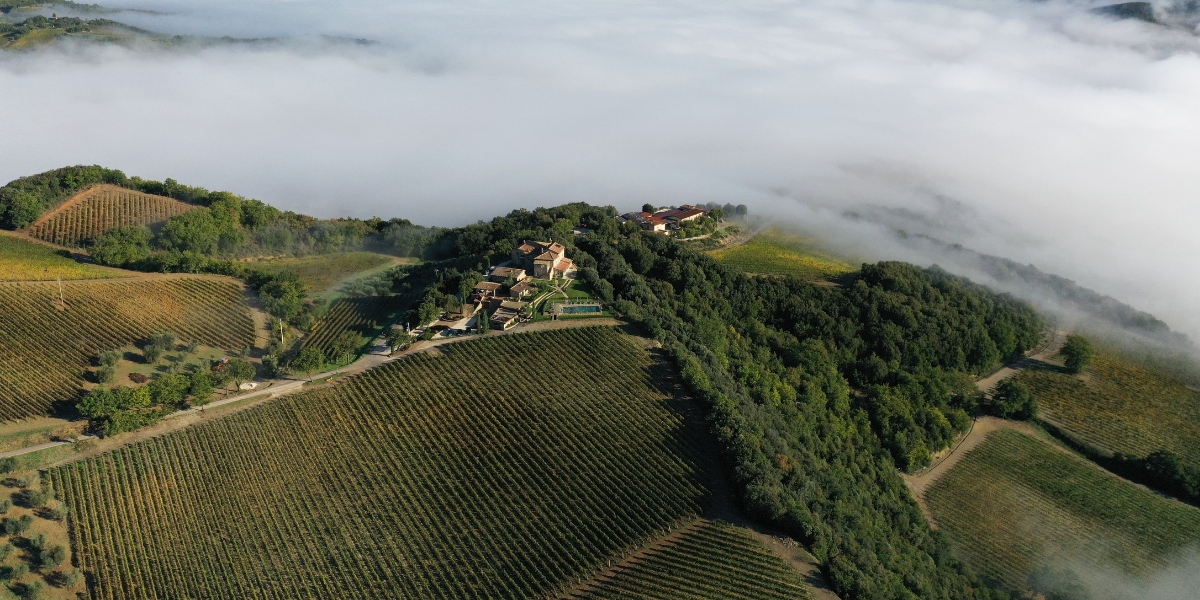
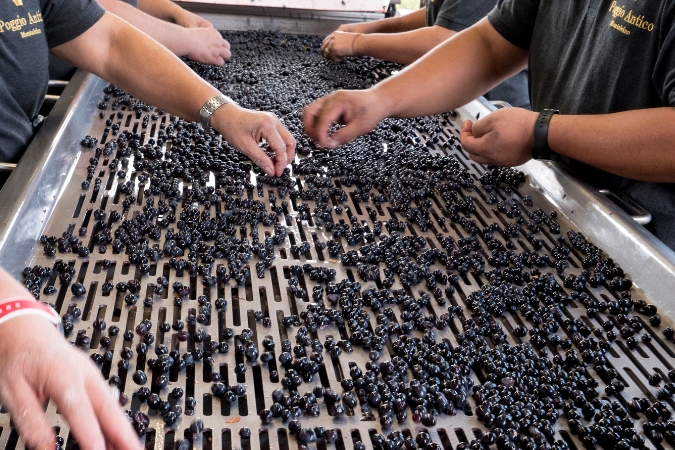
With the ever-shifting climate, the site factor apparently top of mind across the denomination is altitude. Montalcino has always traded on a wine that pushes Sangiovese to generous levels of ripeness without – crucially – losing its balance and an unpredictable climate is hardly conducive to such a sensitive balancing act. Pier Giuseppe d’Alessandro of Poggio Antico, where vineyards rise up to 612m above sea level (asl), says ‘altitude does not mean low temperatures but lower temperatures,’ explaining that during August, the vineyards may be 4-5ºC lower than Montalcino’s lowest sites. The critical factor, he says, is the duration of temperature spikes, which tends to be shorter at altitude, helping avoid vine stress.
Read more: The Brunello di Montalcino Report 2024
However, there are several dynamics at play: fog in the valleys tends to make nights warmer but mornings cooler, reducing diurnal variation, whereas sites above the fogline warm more quickly in the morning but cool rapidly at night, preserving critical acidity. This slows ripening overall and extends the harvest, sometimes to a dramatic degree – Luciano Ciolfi of Sanlorenzo notes that in the difficult 2024 vintage they had to wait until mid-October. However, Giancarlo Tommasi and Emilio Falsini, director of Tommasi Family Estates and enologist of the group’s Montalcino property Casisano say their breezy, high-altitude sites facilitate more uniform ripening and thus more aromatic complexity. Finally, Riccardo Campinoti of Le Ragnaie, known for its high-altitude single site wines, likes that altitude can help reduce vigour and naturally limit yields.
Yet another factor in Brunello di Montalcino is geology. Acidity-preserving stony calcareous soils dominate at higher altitudes, while richer alluvial soils are common lower down, giving altitude pedological as well as climatic significance. In years where the main problem is not intense heat but abundant rainfall, like 2024, the slopes and well-drained stony soils of higher sites can save the vintage.
Montalcino collectively affirmed the importance of altitude in 2015 when it first allowed vineyards above 600m asl into the appellation (whether the region might also have set lower limits on altitude remains an open question). Gianni Pignattai of Pietroso, whose vineyards are mostly between 400 and 500m asl, notes that ripening at these heights was frequently challenging even 10-15 years ago but that they are now his least challenging vineyards to manage, as their lower humidity and greater ventilation allow him to use fewer pesticides.
One thing made clear by the handy 3D map produced for the Forma project is that most of the wine world’s (including the Italian wine world’s) mental image of Montalcino as a roughly cone-shaped protuberance sloping uninterrupted to the flat plain below might need updating. The northern slope of Brunello di Montalcino is indeed more uniform, with only small bumps like Montosoli breaking up its descent. However, the southern stretch is much more topographically varied, with high-altitude sites running all the way south-southwest from Montalcino town to Sant’Angelo in Colle (once unfairly lumped in with the much lower-lying Sant’Angelo Scalo) and south-southeast nearly to the town of Castelnuovo dell’Abate, both about 7km away as the crow flies.
Blends that incorporate at least some high-altitude elements are a snappy riposte to many low-energy bottlings of the mid-2000s
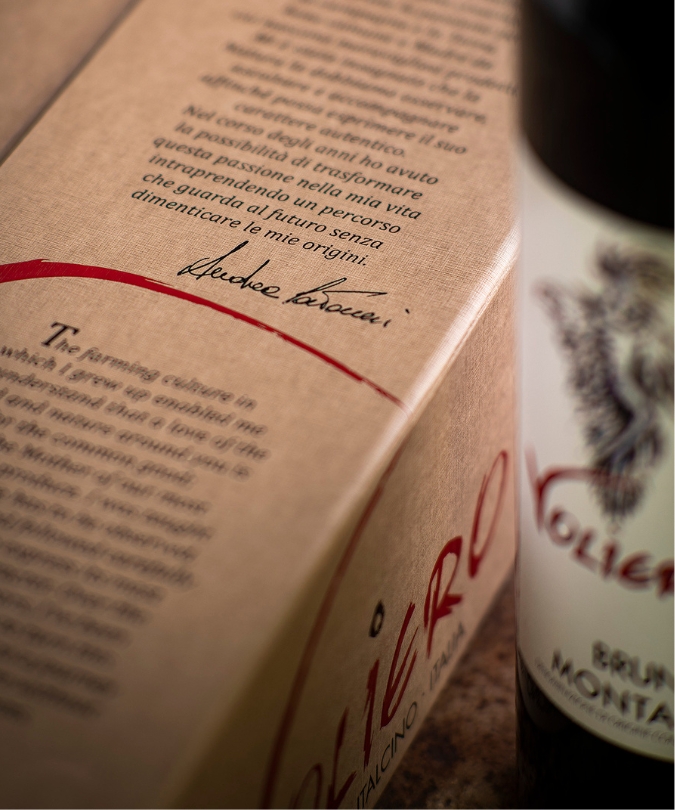
Though multi-site blending remains the norm (and with an increasingly unreliable climate, the blenders may eventually have the last laugh) single site wines from high spots, like Campinoti’s Passo del Lume Spento at 621m asl in Ragnaie, some distance south of Montalcino town, are redefining the upper octaves of Brunello. Meanwhile, blends that incorporate at least some (and often several) high-altitude elements are a snappy riposte to many low-energy bottlings of the mid-2000s. Andrea Cortonesi of Uccelliera based his second brand, Voliero – which, unlike Uccelliera, is blended from across the denomination, including Sant’Angelo in Colle – on the notion that high-altitude sites are linked by consistent (and desirable) characteristics.
On the other hand, there is also clearly some variability among high-altitude wines. Some, like Campinoti’s, trend delicate, tart-fruited and herbal, with alcohol levels (~13.5%) to match. Contrast this with Poggio Antico’s wines, including I Poggi, from their highest active vineyard at 550-575m asl, which is a potent 15%, though with great tension from its dynamite acidity. Exposure, slope and airflows have great impact at these heights – Sanlorenzo’s vineyards sit southwest of Montalcino at 500 asl in two valleys that face southwest towards the Mediterranean and its warming breezes, but Ciolfi says they recently planted some north-facing land in the same area and have just started to vinify the results. Antonio Michael Zaccheo of Carpineto, where vineyards run from 470-500m asl, believes they are the only ones at that altitude with vineyards fully exposed to the north and slopes up to 30%; they typically harvest over three weeks after valley vineyards, with low sugars and elevated acidity.
The challenge is that, with new Brunello plantings frozen since 1997, opportunities to plant higher are limited. Pignattai says though they would like to plant more high-altitude sites, they haven’t found owners willing to sell. D’Alessandro says ‘we do not have higher land to plant because there is no higher land’– Montalcino, unlike Chianti Classico, has no land above 650m asl. However, he is sanguine that with experimental viticultural practices – more dynamic vineyard architecture that permits rapid response to changing conditions – the advantages of higher altitude can be maximised. Giulia Härri, enologist at Mastrojanni, agrees that cultivation techniques are key to altitude’s effectiveness against climate change; she credits their biodynamic viticulture with helping avoid vine stress.
While not a silver bullet, altitude is undoubtedly one factor that may help preserve Brunello’s freshness. Montalcino’s best and brightest are harnessing its power in some of the denomination’s most exciting wines where intense aromatics (and sometime generous ripeness) are offset by gravity-defying acidity.
Eight top examples of altitude-influenced Brunello di Montalcino
| Producer | Name | Vintage | Region | Subregion | ||
|---|---|---|---|---|---|---|
|
Le Ragnaie, Brunello di Montalcino Passo del Lume Spento 2019
Tuscany
, Brunello di Montalcino DOCG
|
Le Ragnaie | Brunello di Montalcino Passo del Lume Spento | 2019 | Tuscany | Brunello di Montalcino DOCG | |
|
Pietroso, Brunello di Montalcino 2019
Tuscany
, Brunello di Montalcino DOCG
|
Pietroso | Brunello di Montalcino | 2019 | Tuscany | Brunello di Montalcino DOCG | |
|
Poggio Antico, Brunello di Montalcino Vigna I Poggi 2019
Tuscany
, Brunello di Montalcino DOCG
|
Poggio Antico | Brunello di Montalcino Vigna I Poggi | 2019 | Tuscany | Brunello di Montalcino DOCG | |
|
San Lorenzo, Brunello di Montalcino 2019
Tuscany
, Brunello di Montalcino DOCG
|
San Lorenzo | Brunello di Montalcino | 2019 | Tuscany | Brunello di Montalcino DOCG | |
|
Voliero, Brunello di Montalcino 2019
Tuscany
, Brunello di Montalcino DOCG
|
Voliero | Brunello di Montalcino | 2019 | Tuscany | Brunello di Montalcino DOCG | |
|
Carpineto, Brunello di Montalcino 2019
Tuscany
, Brunello di Montalcino DOCG
|
Carpineto | Brunello di Montalcino | 2019 | Tuscany | Brunello di Montalcino DOCG | |
|
Casisano, Brunello di Montalcino 2019
Tuscany
, Brunello di Montalcino DOCG
|
Casisano | Brunello di Montalcino | 2019 | Tuscany | Brunello di Montalcino DOCG | |
|
Mastrojanni, Brunello di Montalcino Vigna Schiena d’Asino 2019
Tuscany
, Brunello di Montalcino DOCG
|
Mastrojanni | Brunello di Montalcino Vigna Schiena d’Asino | 2019 | Tuscany | Brunello di Montalcino DOCG |