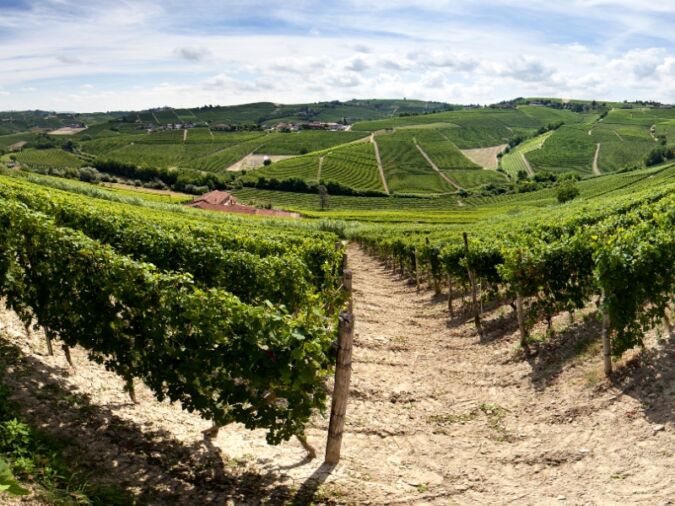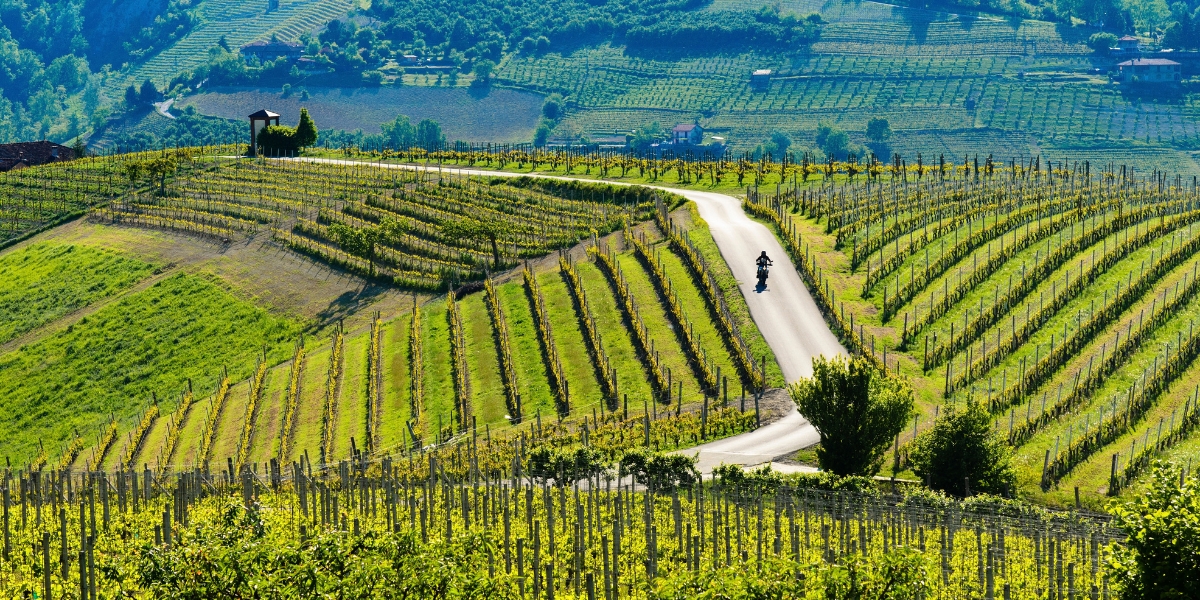
A bike is the best way to take in the undulations of the Langhe. As you ride, you’ll soon become aware that this area of rolling hills divides naturally into two regions. The word langhe is the plural of Piemontese dialect word langa; the word langa – lingua in Italian – means tongue, which is thought to have been used to describe the shape of the hills. The two Langhe are the Bassa Langa, the lower part, which is the area up to about 400 metres above sea level, and the Alta Langa, the higher part, which is comprised of the hills between 400 and 900 metres above sea level. While in recent years vineyards (primarily of white varieties) have been planted in the Alta Langa, this was traditionally an area known for its hazelnuts and such cheeses as Robiola. As an early-budding variety, Nebbiolo is planted almost exclusively lower down in the Bassa Langa because the spring frosts at higher altitudes make it all but impossible to cultivate above 400 metres.
As a result, the vineyards of Barolo and Barbaresco are situated solely in the Bassa Langa, which starts to rise south of the Tanaro River. The road continues to ascend as you cycle from north to south: whether on the eastern border from Grinzane Cavour to Roddino, which is just south of the border of the zone, or from the hamlet of Uccellaccio to Monforte d’Alba through the centre of the region, or from Verduno to Novello on the western boundary, there is no escaping the climb.
Through Barolo and Barbaresco, the hills are dotted with small huts or refuges called ciabots. In Burgundy, similar constructions are called cabottes, illustrating that the affinity between these two regions is not just cultural and legal but also linguistic
The Langhe hills are situated just over an hour’s car drive south of Turin (Torino), two hours northwest of Genova and two hours southwest from Milan. To the south is the Ligurian coast, whose influence can still be seen in the food of the Langhe, while the road due north takes you to Switzerland. To the west lie the Alps and the French border. This proximity to France has led to Turin being described as the most French city in Italy. The House of Savoy, the family that ruled this part of Italy until the late 1840s, was originally part of the Kingdom of Burgundy, but it grew to bestride the Alps, its duchy taking in not only Turin but also Chambéry.
French influence remains strong in this area. As you drive, cycle or walk (the Langhe provide superb conditions for walking. The paths through the vines are very well sign-posted, and the climbs are tough enough to help build an appetite for a good lunch but not so challenging you won’t be able to eat it!) through Barolo and Barbaresco, the hills are dotted with small villages and hamlets, clumps of trees and, in the middle of many vineyards, a small hut or refuge which was used to store equipment and provide shelter for vineyard workers who spent the entire day tending the vines. These small buildings are called ciabots. In Burgundy, similar constructions are called cabottes, illustrating that the affinity between these two regions is not just cultural and legal but also linguistic.
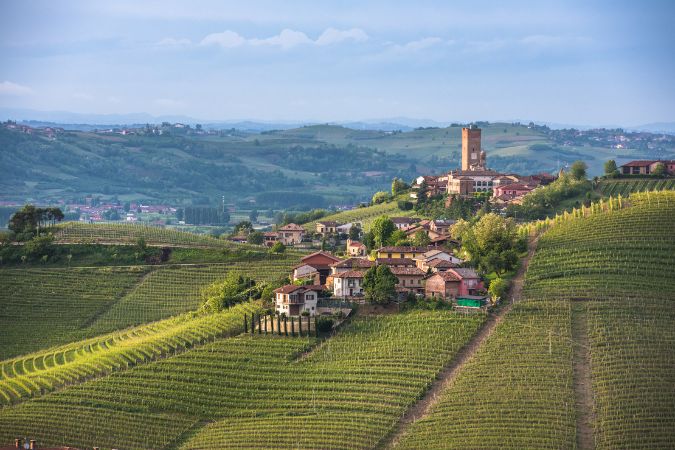
Barolo and Barbaresco are situated either side of the city of Alba. The city is located in the valley of the Tanaro, which separates the Langhe from the Roero hills to the north. It is a relatively affluent city today, thanks in part to wine and white truffles, but also to the success of Ferrero, makers of Nutella, Kinder and Ferrero Rocher chocolates. Its success was originally based on hazelnuts, which were cheap and plentiful in the Langhe in the decades after World War II. (The food writer Elizabeth David said in the 1950s that the best hazelnuts in Italy came from the Langhe and the Irpinian Hills east of Naples.) Starting with just two Ferrero brothers in a family shop in Alba in 1946, today it employs about 6,000 people in the town but close to 50,000 around the world.
As Ferrero grew rapidly in the 1950s and 1960s, many of its early employees came from the villages in the Langhe. Michele Ferrero’s genius was to realize that he had a pool of labour available in the impoverished communities in these inhospitable hills. Ferrero could easily have hired only those who had moved to the city, but the firm needed that labour to stay on the land to cultivate the hazelnuts on which the company’s success was built. As a result, he organized buses to collect his employees from the hills every day, and to return them home after a day’s work. Without this investment, the depopulation of the Langhe, particularly the Alta Langa, may have been so dramatic as to damage agriculture generally and viticulture specifically, at a time when grape and wine prices were already low.
The road out of Alba is flat, but both sides of the broad valley are flanked by fairly steep hills. To the east of Alba, the ‘old’ road to Barbaresco climbs quickly, past the Ferrero family house and on to the vineyards of Pertinace, Roncaglie and Sorì Tildìn (in Roncagliette) before passing the hamlet of Tre Stelle, after which you turn left and soon arrive at the village of Barbaresco.
The road from Alba to Barolo is longer and flatter, as the hills don’t begin until just after the town of Gallo. It takes time to understand the topography of Barolo. Pietro Ratti of the Ratti winery in Annunziata compares the Barolo zone to a crown: ‘The hills ring the vineyards, which are inside the crown.’ Within this crown, there are three chains of hills that run north to south, one guarding the eastern flank and another the western flank, while the third is a spur that bisects these two flanks. Smaller hills come off these main chains in a ‘tongue and groove’ structure; the tongues are the long chains and the grooves the smaller hills that run perpendicularly from the spine of the main chain.
It takes time to understand the topography of Barolo
The finest vineyards in Barolo are south- or southwest-facing. Particularly in the more compressed eastern part of the zone, they are situated on the small grooves that run off the main chain: whether Marenca, Vigna Rionda, Villero or Monprivato they produce wines to conjure with. In the western valley, the vineyards sun themselves on more commodious slopes, which stretch languidly in a southeast-facing direction.
In Barbaresco, many of the vineyards are east-facing, while in Barolo they tend to face south. In fact, the name sorì, Piemontese dialect for sun or sunny, is given to the warmer, generally south-facing sites where the snow used to melt first and the vegetation regenerated more quickly after a winter under snow. Such sites were important for Nebbiolo, as it is the earliest variety to bud and the last to ripen, so it needed those warmer sites to reach full ripeness.