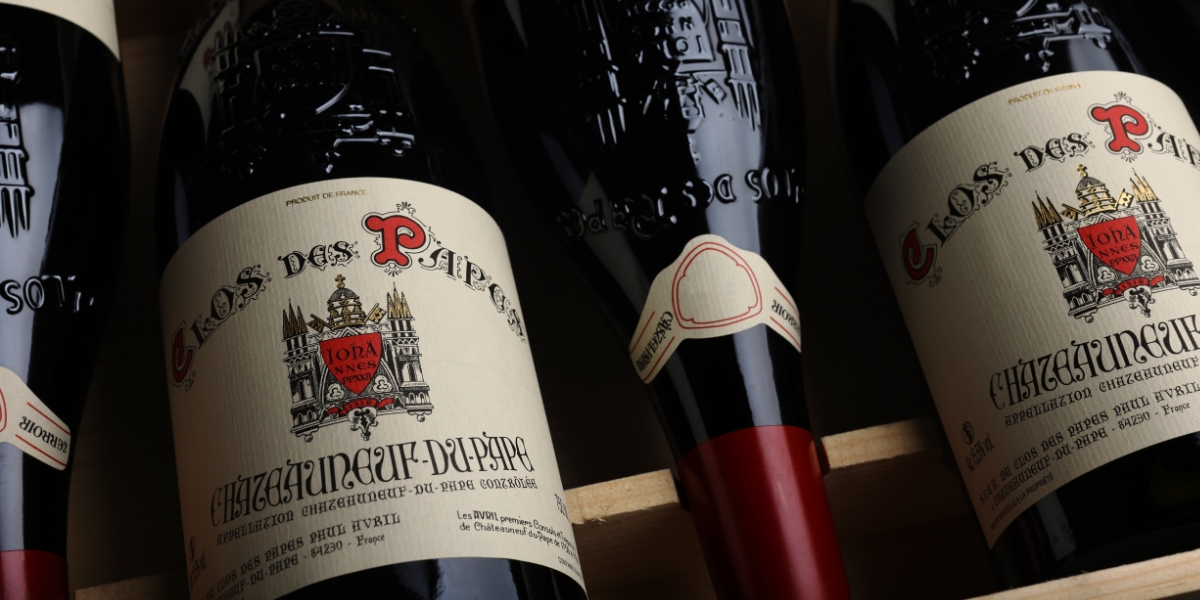
The key words that spring to mind when describing Clos des Papes are ‘elegance’ and ‘consistency’. Whilst the common perception of Châteauneuf-du-Pape is (usually correctly) one of power and richness, Clos des Papes possesses a restraint and an almost Burgundian character that very few other wines from the region do.
The consistency of Clos des Papes wines is largely thanks to the stability behind the scenes, and that over the decades there have only been minor tweaks in the approach and philosophy of this great domaine in the Southern Rhône. Winemaker Vincent Avril took over from his father Paul in 1987 and is currently on his 38th vintage. ‘I have changed very little of what my father did. The biggest change has been a deeper focus in the vineyard, as I would say that 80% of the work is done in the vineyard itself. And, of course, the soils are key: we have 24 different plots and 24 different soil types, which is a blessing.’
Clos des Papes possesses a restraint and an almost Burgundian character
There has only ever been one red and one white cuvée produced here, with Avril showing no interest in following the trend for cuvée speciale, which all too often can be even more powerful and weightier than the traditional cuvées. One of the more significant changes has been the changing grape mix in the vineyard, with less Grenache and more Mourvèdre. ‘Chateauneuf is the most northern outpost for Mourvèdre in France, and it gives a brightness and wildness and spice to the wines in their youth. We now have around 55% Grenache, 30% Mourvèdre, 10% Syrah and the balance is Counoise and Cinsault.’

According to Avril, the most important thing for his wines is tannin and phenolic maturity. He never picks on sugar content but on tannin ripeness. ‘If your tannins aren’t ripe then you will feel the alcohol far more. If the tannins are ripe then you will automatically have better balance and alcohol integration. I also believe that the quality of tannins is fundamental for the ability to age. For that reason, I also only use old foudres and never any new oak; I don’t want oak tannins in the wine, I want to taste the grapes, the soil and the place.’
At Clos des Papes, the reds are always co-fermented with two varieties together. When I ask what this brings, Avril explains that ‘the wines are just more complete when fermented and blended from the beginning. My father and I did trials every year of single ferments and co-ferments and then we tasted the results; we always chose the co-ferments, they are deeper and more complex.’ As this vertical tasting demonstrated, they are certainly wines with profundity, complexity and an incredible capacity for ageing.
On the issue of climate change, it was interesting to hear Avril’s thoughts on the impact it has had on Clos des Papes over the decades. ‘This really hasn’t had a huge amount of difference, especially not compared to places like Burgundy. We are now only harvesting on average two to three days earlier than we were 30-40 years ago. But what we have are more peaks, so we may see a huge downpour of 100mm of rain in an hour, and we certainly see less rainfall in summer. So it is more extremes but not necessarily warming.’ One effect on the winemaking as a result of these changes, however, was the decision made in 1992 to totally de-stem the fruit. With less rain in the summer, the stems do not get fully ripe and therefore would potentially add a greenness to the wines, thus undoing all the hard work of the judicious tannin management.
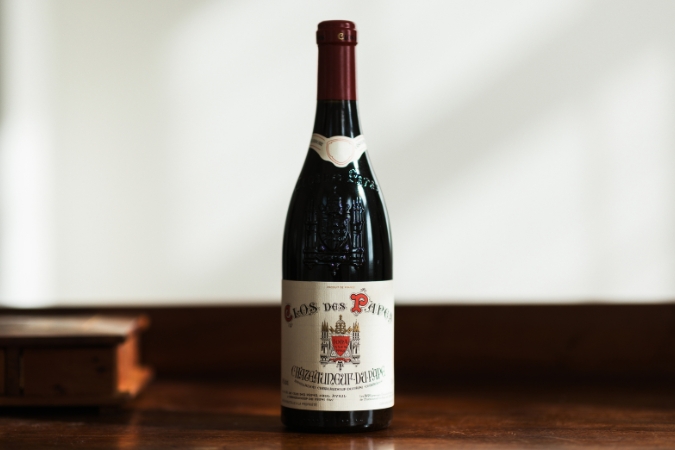
The white wines are somewhat atypical in terms of Châteauneuf for several reasons. Firstly, they are a blend of six varieties, all contributing in different ways. Grenache and Rousanne give richness but can lack acid, Clairette and Picardin add elegance and the freshness comes from Bourboulenc and Picpoul. Secondly there is no oak or malolactic fermentation and the wines are bottled very early, normally in February following harvest. For Avril, the whites nearly always follow the same maturity: ‘The young wines show peach, anis, white flowers, grapefruit and a salinity. As they age, they become more mineral and almost show a Riesling like petrol note. And then heading towards 20 years we see honey, dried apricots and quince appear.’ These are whites that do have a freshness that many other whites from the appellation do not have, yet never at the expense of the textural richness that is integral to their identity.
I consider Clos des Papes wines to be extremely good value for money
The tasting demonstrated perfectly the trajectory that Clos des Papes wines tend to follow as they age. In their youth, they offer very attractive drinking for two to three or so years after bottling with primary fruit and a suave feel as demonstrated by the 2021, 2022 and 2023. The wines then tend to shut down in bottle, as seen with the 2019, which whilst having a spellbinding nose was quite tight on the palate but with such balance. The 2016 was still somewhat tight but just beginning to unfurl and open up, while the 2010 was drinking just beautifully yet clearly with great potential to develop further. The coup du coeur for me was the quite magnificent 2005, which still maintains such tannic structure and grip but with beautiful fruit, texture and minerality. Again, this seemed to be dipping into a quieter phase as well and I expect it will age gracefully for another 20 years.
Clos des Papes is a wine that should be on every Rhône lover’s radar. Firstly, I consider them to be extremely good value for money. They are wines that offer so much pleasure over such a long period of time yet can still be enjoyed in their youth. Each vintage really does speak of the year yet with the hallmark of Clos des Papes, as Avril explains, ‘I compare my job to that of a painter. At the beginning of the year, I get a blank canvas and the weather is what gives me the colours with which to paint the best picture possible. Each year the resulting painting will be different but always with the same signature beneath.’ Vincent Avril is a man that makes it all sound so simple, yet the wines are anything but and offer incredible complexity, elegance and refinement.
Clos des Papes 2005-2023
| Producer | Name | Vintage | Region | Subregion | ||
|---|---|---|---|---|---|---|
|
Clos des Papes, Rouge 2023
Rhône
, Châteauneuf-du-Pape AOP
|
Clos des Papes | Rouge | 2023 | Rhône | Châteauneuf-du-Pape AOP | |
|
Clos des Papes, Rouge 2022
Rhône
, Châteauneuf-du-Pape AOP
|
Clos des Papes | Rouge | 2022 | Rhône | Châteauneuf-du-Pape AOP | |
|
Clos des Papes, Rouge 2021
Rhône
, Châteauneuf-du-Pape AOP
|
Clos des Papes | Rouge | 2021 | Rhône | Châteauneuf-du-Pape AOP | |
|
Clos des Papes, Rouge 2019
Rhône
, Châteauneuf-du-Pape AOP
|
Clos des Papes | Rouge | 2019 | Rhône | Châteauneuf-du-Pape AOP | |
|
Clos des Papes, Rouge 2016
Rhône
, Châteauneuf-du-Pape AOP
|
Clos des Papes | Rouge | 2016 | Rhône | Châteauneuf-du-Pape AOP | |
|
Clos des Papes, Rouge 2010
Rhône
, Châteauneuf-du-Pape AOP
|
Clos des Papes | Rouge | 2010 | Rhône | Châteauneuf-du-Pape AOP | |
|
Clos des Papes, Rouge 2005
Rhône
, Châteauneuf-du-Pape AOP
|
Clos des Papes | Rouge | 2005 | Rhône | Châteauneuf-du-Pape AOP | |
|
Clos des Papes, Blanc 2023
Rhône
, Châteauneuf-du-Pape AOP
|
Clos des Papes | Blanc | 2023 | Rhône | Châteauneuf-du-Pape AOP | |
|
Clos des Papes, Blanc 2021
Rhône
, Châteauneuf-du-Pape AOP
|
Clos des Papes | Blanc | 2021 | Rhône | Châteauneuf-du-Pape AOP | |
|
Clos des Papes, Blanc 2020
Rhône
, Châteauneuf-du-Pape AOP
|
Clos des Papes | Blanc | 2020 | Rhône | Châteauneuf-du-Pape AOP | |
|
Clos des Papes, Blanc 2015
Rhône
, Châteauneuf-du-Pape AOP
|
Clos des Papes | Blanc | 2015 | Rhône | Châteauneuf-du-Pape AOP |