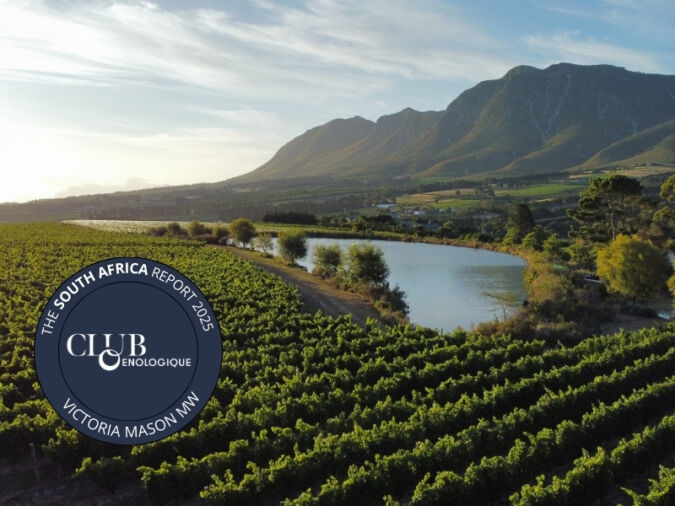
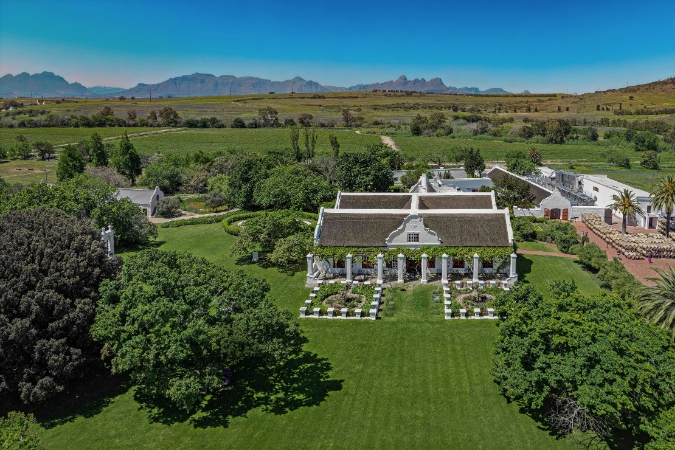
Meerlust is the oldest family business in South Africa. In the hands of the Myburghs continuously since 1756, the property itself dates to 1693 and grapes have been grown and crushed on site since 1704. This sense of history – and its accompanying gravitas – permeates the public perception of the estate and its wines, and rightly so, but does mean that Meerlust’s credentials as a pioneer, having recognised and realised the potential of Bordeaux-style blends in Stellenbosch, are often overlooked.
While vines had been farmed and wine made on Meerlust for centuries, the results were historically traded in bulk or for ‘kitchen consumption.’ It was seventh-generation Nico Myburgh, the father of current proprietor Hannes Myburgh, who had the vision to begin production of his own labelled estate wine, bottling three barrels of Cabernet Sauvignon from the 1975 vintage and releasing this to the market in 1978.
Rubicon is a wine that marked South Africa’s entry into new territory
The first estate wine may have been made from a single variety but the wheels were already turning for Myburgh to achieve his dream of making a Bordeaux-style red. A trip to Bordeaux in 1967 was the catalyst, opening Myburgh’s eyes to the similarities in both climate and soil that exist between maritime Bordeaux and Meerlust’s home in the Eerste River Valley in Stellenbosch, 5.2km away from False Bay. Cabernet Sauvignon was already in the ground but a few years after that pivotal Bordeaux holiday, he planted Merlot and Cabernet Franc as well, making Meerlust the first producer to plant Cabernet Franc in Stellenbosch. The inaugural experimental three-way blend, comprising 70% Cabernet Sauvignon, 20% Merlot and 10% Cabernet Franc, was made by Myburgh and winemaker Giorgio Dalla Cia in 1978. The proportions were modelled simply on the average ratio of plantings in Bordeaux at the time.
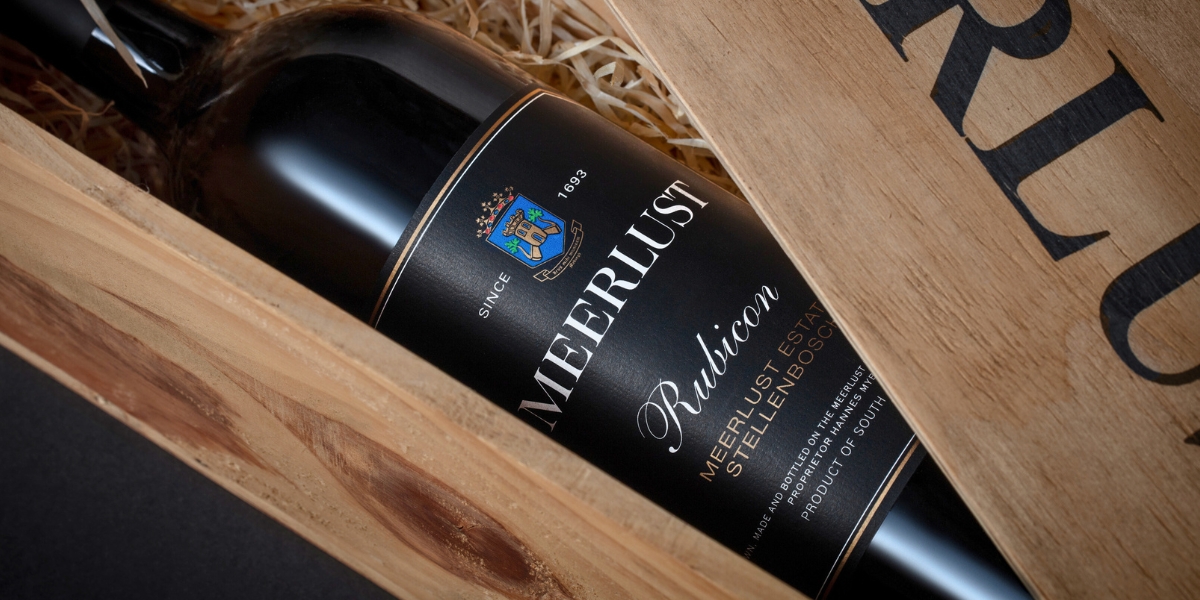
The first commercial release of the blend, built on those same varietal proportions, was not until 1984, with the 1980 vintage; this wine was christened Rubicon, a name that has a sense of majesty, presence and conviction. As South Africa’s oldest Bordeaux blend still in production, it deserves this aura and, as this vertical tasting unequivocally showed, the liquid in the bottle delivers on the name’s promise. The Cambridge Dictionary defines ‘to cross the Rubicon’ as ‘to do something that you cannot later change and will strongly influence future events.’ Rubicon is a wine that marked South Africa’s entry into new territory – difficult to imagine now that ‘Bordeaux blends’ is one of the most established fine-wine categories in the Western Cape – and there was to be no subsequent retreat from the style.
I tasted through five decades of Rubicon, from the 1981, the second vintage produced, through to the 2022. While the 1981, 1991 and 2001 all elegantly evidenced the ageing potential of Rubicon, the focus of the tasting was on the last two decades, tasting every vintage from 2012 to 2022 (there was no 2019; it was declassified into Meerlust Red due to a cold, wet February).
Reviewing these more recent vintages, wines that were still in their first flush of youth, made it clear that Rubicon is an honest translator of vintage conditions. For example, tasting 2014 and 2015 side by side proved fascinating because the distinct characters of each were true to their starkly different vintages; the wetter 2014 vintage giving rise to an understated but beautiful Rubicon, with the emphasis more on minerality than fruit; while the ripe and powerful 2015 was hugely structured, concentrated and mighty, nodding to the warm, dry vintage and demanding (much) more time in the cellar. Any great wine should articulate the particularities of a given year and Rubicon does so with thrilling precision.
While being true to vintage and despite the natural evolution brought about by 45 years of winemaking, there is an inherent and effortless elegance at the heart of every Rubicon: a brightness of fruit, a refreshing, appetising aspect and a mid-weight stature. The moderating influence of the sea is always felt on the property, often in the constant drive of wind, and means that Meerlust does not endure the heat spikes experienced by many other parts of Stellenbosch; very few hours above 35°C are recorded on the farm, the majority spent between 25 to 30°C. This mild climate is responsible for a fruit expression that shows restraint in its ripeness, often with an herbal lift and a graphite or gravelly minerality.
Rubicon is one of South Africa’s most affordable fine wines and represents incredible value when you consider its ageing capacity
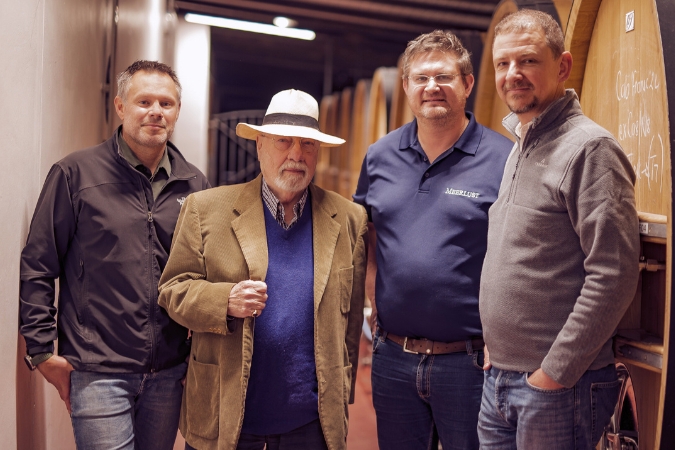
In the last decade, extensive soil profiling has taken place at the estate to better understand what varieties will thrive where and, since 2020, replanting has begun under the supervision of cellarmaster and managing director Wim Truter, who joined in May of the same year. Anything that didn’t make it into the 2020 Rubicon was uprooted in 2021. As winemaker Altus Treurnicht said to me while we drove around the vineyards on a grey winter’s day, they are ‘still learning… like the monks, figuring this out.’ At this juncture, it is worth pausing to think about how long it took the monks to ‘figure out’ the best terroirs of Burgundy. For now, this detailed analysis has helped the Meerlust team to identify four distinct terrains, the knowledge of which is informing their replanting decisions, as well as enabling a tailored approach to farming.
What excites most about Rubicon, in addition to the increased viticultural precision, is that it is both the flagship and the volume wine of Meerlust. It represents around half of Meerlust’s annual production, so is made in sufficient quantities to populate collectors’ cellars across the globe, like many a classed growth Bordeaux but unlike many of South Africa’s most sought-after labels, which are made in minuscule quantities. Rubicon is also one of South Africa’s most affordable fine wines and represents incredible value when you consider its ageing capacity. For South African and, I’d argue, Bordeaux wine lovers alike, this bona fide Cape Classic is a cellar essential.
Meerlust Rubicon: 1981-2022
| Producer | Name | Vintage | Region | Subregion | ||
|---|---|---|---|---|---|---|
|
Meerlust, Rubicon 2022
Coastal Region
, Stellenbosch
|
Meerlust | Rubicon | 2022 | Coastal Region | Stellenbosch | |
|
Meerlust, Rubicon 2021
Coastal Region
, Stellenbosch
|
Meerlust | Rubicon | 2021 | Coastal Region | Stellenbosch | |
|
Meerlust, Rubicon 2020
Coastal Region
, Stellenbosch
|
Meerlust | Rubicon | 2020 | Coastal Region | Stellenbosch | |
|
Meerlust, Rubicon 2018
Coastal Region
, Stellenbosch
|
Meerlust | Rubicon | 2018 | Coastal Region | Stellenbosch | |
|
Meerlust, Rubicon 2017
Coastal Region
, Stellenbosch
|
Meerlust | Rubicon | 2017 | Coastal Region | Stellenbosch | |
|
Meerlust, Rubicon 2016
Coastal Region
, Stellenbosch
|
Meerlust | Rubicon | 2016 | Coastal Region | Stellenbosch | |
|
Meerlust, Rubicon 2015
Coastal Region
, Stellenbosch
|
Meerlust | Rubicon | 2015 | Coastal Region | Stellenbosch | |
|
Meerlust, Rubicon 2014
Coastal Region
, Stellenbosch
|
Meerlust | Rubicon | 2014 | Coastal Region | Stellenbosch | |
|
Meerlust, Rubicon 2013
Coastal Region
, Stellenbosch
|
Meerlust | Rubicon | 2013 | Coastal Region | Stellenbosch | |
|
Meerlust, Rubicon 2012
Coastal Region
, Stellenbosch
|
Meerlust | Rubicon | 2012 | Coastal Region | Stellenbosch | |
|
Meerlust, Rubicon 2001
Coastal Region
, Stellenbosch
|
Meerlust | Rubicon | 2001 | Coastal Region | Stellenbosch | |
|
Meerlust, Rubicon 1991
Coastal Region
, Stellenbosch
|
Meerlust | Rubicon | 1991 | Coastal Region | Stellenbosch | |
|
Meerlust, Rubicon 1981
Coastal Region
, Stellenbosch
|
Meerlust | Rubicon | 1981 | Coastal Region | Stellenbosch |