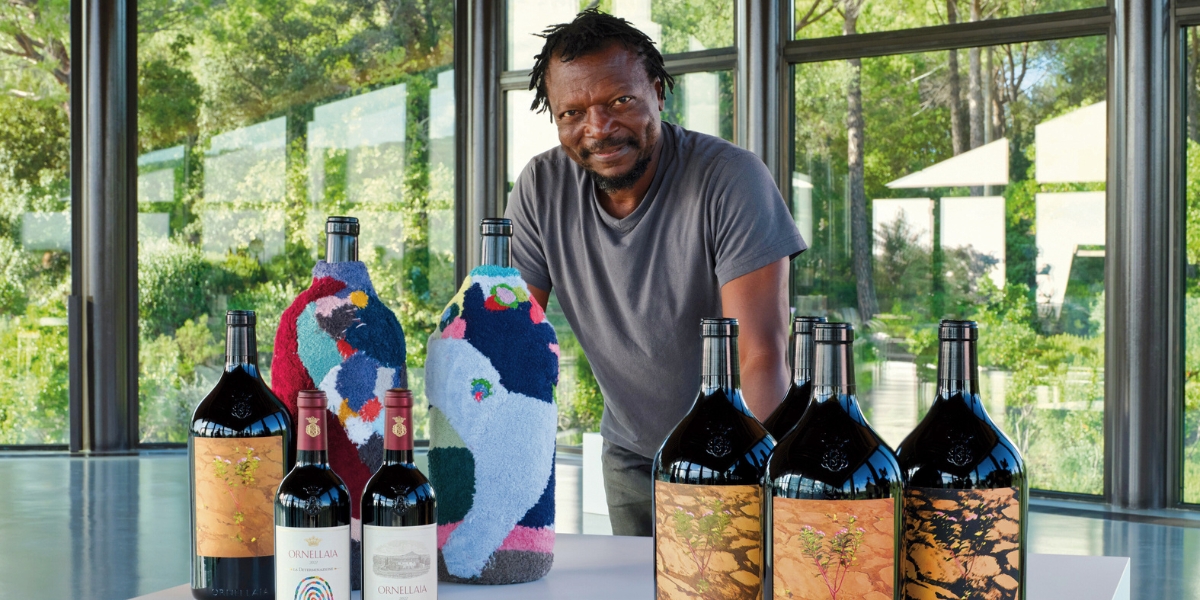
If any artistic endeavour is about overcoming difficulty and wresting meaning from intransigent clay, or paint, or any other medium, then surely the wine bottle must be the most challenging canvas of all. When Pascale Marthine Tayou was asked to create something for Ornellaia’s Vendemmia d’Artista series, his first thought was, ‘this is not so easy but it’s something maybe for me to solve.’
Tayou is a cosmopolitan figure. Born in Nkongsamba, Cameroon, in 1967, he divides his time between Ghent in Belgium and Yaoundé, Cameroon. He’s lived in Sweden and France, and has worked all over the world; he has had critically acclaimed shows at London’s Serpentine Gallery, in Dubai, Madrid, Gstaad and Beijing. He also has form when it comes to wine. He took part in a 2024 exhibition by Champagne Ruinart, with a piece featuring vine roots and deer horns. One of his works, Mikado Tree, stands in the sculpture garden of Donum Estate in Sonoma; and having had a major exhibition in San Gimignano, he knows Tuscany.
His work tends to be monumental, dramatic and difficult to categorise. The Serpentine describes his ‘mysterious human forms and fantastical beasts – such as the 100-metre snake of Africonda; the hanging, giant toothpick-studded woollen clouds of Coton Tige; or Octopus, a scarily lifelike creature made from petrol pump hoses.’
However diverse his media – cloth, glass, rubber, metal, found objects – his works fill large spaces. How did he approach something as small as a wine bottle?
The project was interesting, he says, speaking on Zoom from his studio in Ghent. He approached it by looking for the particular, rather than the grand statement: ‘I went looking for things deep inside myself that could be in line with the idea of a plant’s lifecycle. For example, I found a picture of a flower I did in Africa a long, long time ago, a little flower growing on stone. In a way, it became a symbol of what I wanted to express. I thought I would start with this.’
Our connection with nature is a thread that runs through his work, ‘My tradition is the human condition’, he says. We are part of the ‘the global village’; at Ornellaia, he noticed how wine ‘brings a special music to the phenomenon of binding people together’.
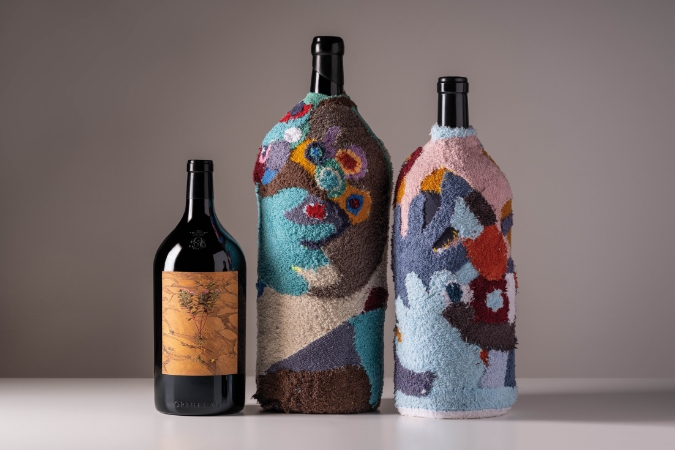
There’s something powerfully resilient in one of his Ornellaia labels – that robust little plant growing out of a marbled, desert-like landscape – and it doesn’t take any leap of imagination to see that resilience as an equally human trait.
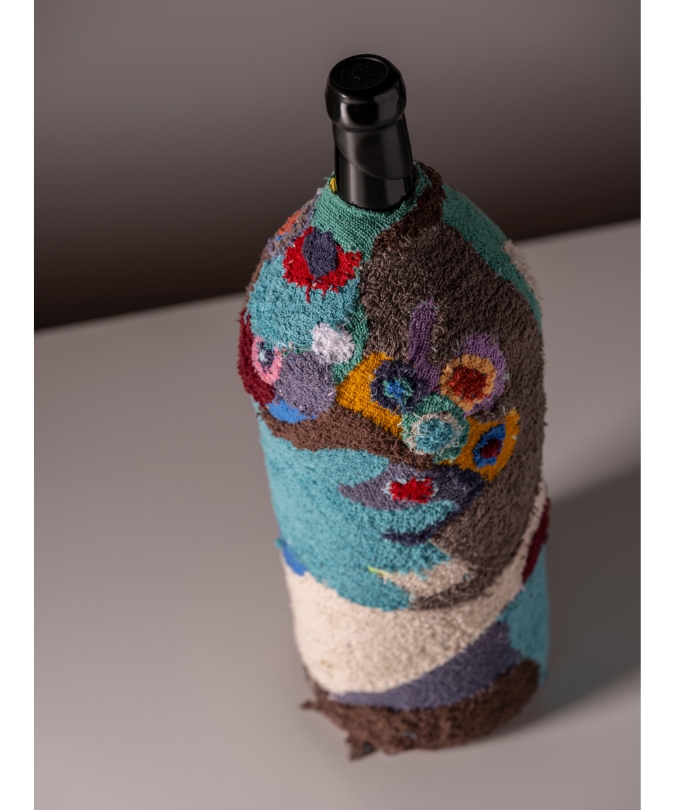
Even more striking are the multicoloured, knitted woollen sleeves he’s conceived for the large-format bottles. They look cosy and enveloping, the very thing you’d think of to protect a precious bottle. But there’s far more. They have the Serpentine’s ‘mysterious human forms and fantastical beasts’ – you can see a round, staring eye, the hint of a face. They seem to be both inviting and on guard.
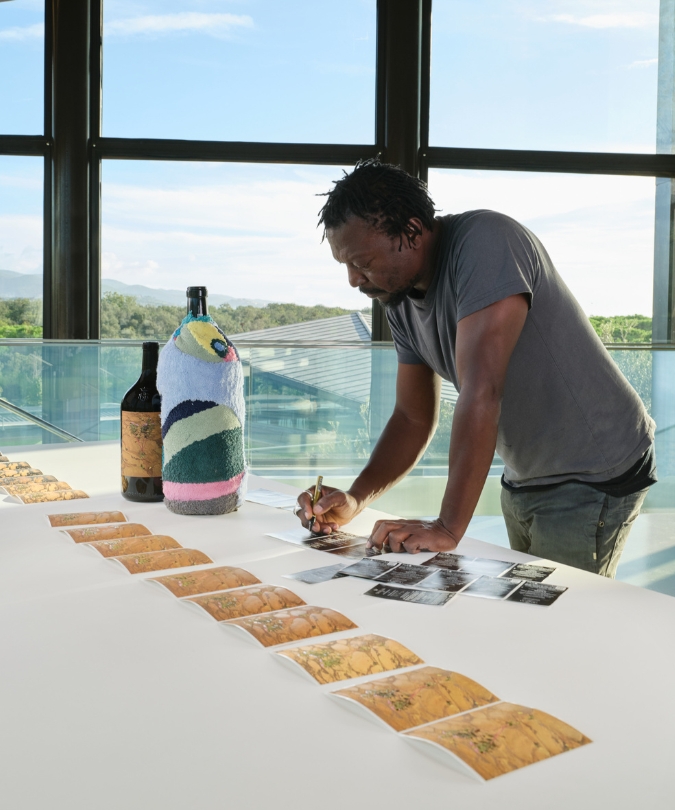
‘I used materials that would push me and even techniques that would push me,’ Tayou says. ‘I wanted to dress the bottles with as much love as I could.’
His theme, as he’s reiterated in interviews, is the universality of the human condition. He returns again and again to the idea of human resilience. He describes the ‘determination’ to create a wine and all it goes with – to foster un rapport de convivialité – as ‘a form of commitment, of courage. It could even be related to resilience, resistance.’
There’s something timeless and un-categorisable about Tayou. In the mid-1990s (then called Jean Apollinaire Tayou), he gave up law studies at the University of Yaoundé in Cameroon to devote himself to art. He deliberately feminised his name because he ‘wanted symbolically to underline that there is no comparison between the genders, that there is a form of fusion between people,’ he said in 2022. ‘Of course, there can be a difference, but it is important that there is the fusion of these differences.’
He’s like the seer Tiresias in The Waste Land, ‘throbbing between two lives’. He’s also fascinated by the fact that Pascale means Easter; just as Easter is a time of renewal, so, ‘every day is to start into light, starting a new life’.
If I’ve painted Tayou as some sort of fey, riddling oracle, let me assure you there’s nothing otherworldly about him. Nearing 60, he’s a solid-looking, courteous, cheerful presence on my screen, quick to smile, ready to talk about Cameroonian football, but perfectly serious in trying to explain the ineffable.
He makes a good fist of it but in the end the works speak for themselves. That flower growing out of a red rock is as eloquent a symbol of resilience as a thousand words; the mysterious woolly guardians of the imperial (six-litre) and salmanazar (nine-litre) bottles show another facet of the human condition besides resilience: the need to nurture and protect, to offer a safe harbour. And there’s a certain sadness – the rock flower is alone in the desert, after all. Tayou (I didn’t ask him this) might well admit that he’s worried perhaps we’re all too fragile.
On the wall behind him is one of his works, a dark background on fabric with constellations of light. It’s about space, he says. I don’t fully catch what he says next (after a long pause as he thinks about how he can describe it), but it sounds like, ‘it’s about the human patient’.
The human patient, I say. Another substantial pause.
‘Yes, People who get up every day and they think about treasure, and sometimes they don’t really understand that the treasure is themselves.’
A selection of the large-format bottles (including the sole nine-litre bottle) were auctioned online via a Bonhams auction between 12-24 June. A donation from the proceeds of the auction was made to the Solomon R. Guggenheim Foundation to support the upcoming exhibition Collection in Focus: Modern European Currents, which opens on 15 July at the Guggenheim in New York.