Wine tourism in the UK is booming, with Wine GB reporting that it now accounts for 25% of revenue at many estates. Visitor numbers to wineries have increased by 55% since 2022 to an average of 1.5m visits a year and are expected to grow by another 20% over the next five years. Yet not all this activity is taking place in the bucolic English countryside: enter the urban winery.
Since 2013, four big urban wineries have opened in London. Outside the capital, there’s Midland Press, a recent addition in Birmingham founded by Richard Stenton in 2024, and Gutter and Stars, housed in an old windmill in Cambridge, which was established by music journalist-turned winemaker Chris Wilson in 2020. There are now also wineries in Chichester and Canterbury. In London, RAD in Royal Albert Dock and Numbers Wine run by an Australian couple in Hackney are smaller projects just getting started, while the latest large opening is Vagabond (one of the aforementioned London big four), over in Canada Water. Vagabond’s previous site in Battersea was set up by Gavin Monery, who had worked at London Cru, London’s first urban winery.
‘It’s quite striking that we’re the oldest,’ says Sarah Wright, assistant winemaker at London Cru in Fulham, ‘but we only started in 2013’. Denver-born Wright’s first experience of wine, long before she started making it herself, was in California’s urban wineries. ‘When a winery is easier to get to, it makes [the experience] much more democratic.’ Part of the appeal of urban wineries is that a car is often unnecessary to get to them, they are easy to reach for a quick drink of an evening and open all year round.
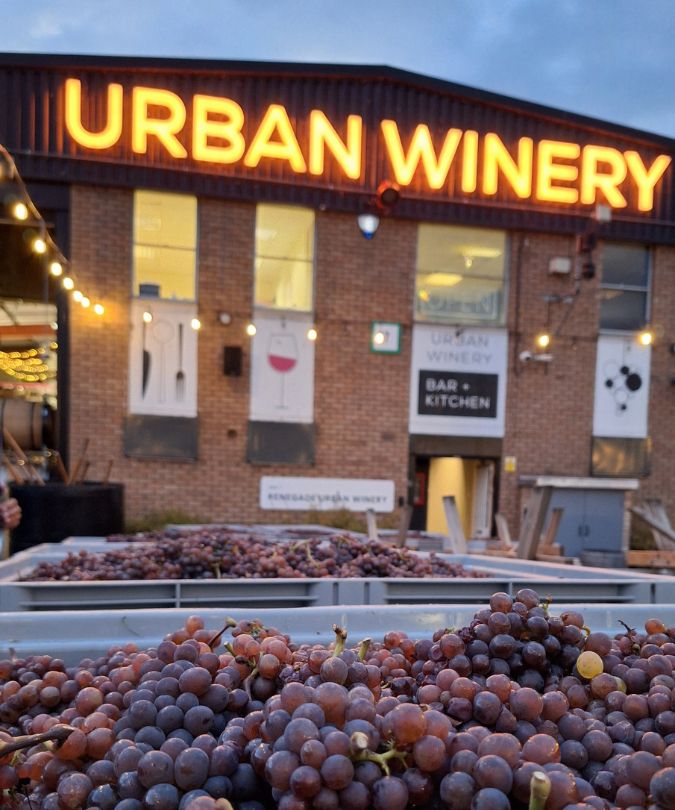
In tune with this idea, José Quintana, winemaker at Vagabond, says that for them, it is not about ‘trying to chase what the London crowd wants’ but ‘trying to democratise wine’. At Vagabond, this shows itself in several ways: an app to help guide customers through the tasting process, for example, means you don’t need prior knowledge of wine or how to approach it. The new site also offers blending and component masterclasses, as well as introductory WSET courses. Internally, Quintana also makes a collaborative wine each year with Alex Brogan (winner of the IWSC’s 2023 Emerging Talent in Wine Trophy) from Not Yet Named Wine Co. in conjunction with the rest of the Vagabond team, who contribute their ideas to the blend, style and country of origin. The labels on ‘Swart TF is This?”, made with Adi Badenhorst in South Africa, are decorated with Vagabond’s staff signatures.
Quintana and Vagabond are also quick to champion other urban wineries in the UK and talk about ‘being totally collaborative with them’, feeding into a spirit of ‘anti-protectionism’. Alongside the Vagabond core wine range, there is also a rotating selection of some of England and Wales’s finest. ‘We’re confident and love what we do but we’re inspired by the others – we know them as friends. It’s fantastic to have the opportunity to work together.’ This extends to a newly formed London Urban Winery Collective, which is organising a collaborative party at Vagabond this June to coincide with English Wine Week (June 20-28).
Urban wineries are easy to reach for a quick drink of an evening and open all year round
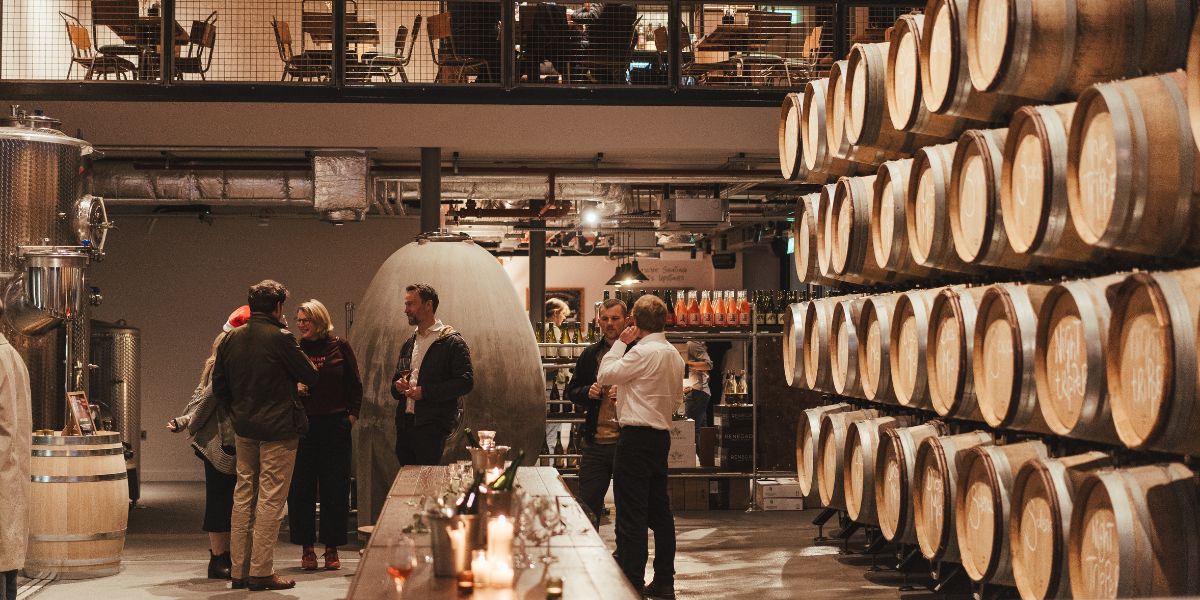
Many of the urban wineries have their own USPs. ‘Blackbook [in Battersea] sells into trade; LDN CRU has its own distribution; Vagabond focuses on hospitality.’ says Quintana. But what they have in common is experience; each delivers a hands-on opportunity for customers and trade alike to come and visit the wineries, take part in hosted tastings and leave having been up close with tanks, barrels and the like. There is also an emphasis on encouraging members of the local community to participate in harvest, fill bottles and take a stab at labelling. Fundamentally, the urban winery model enhances a person’s interaction with and experience of wine. ‘I once drove to Blackbook winery with a tub on the roof’ says Quintana, talking about a wine he made (the aptly named Night Tripper) from grapes he was offered last minute but had no room to process. ‘That’s the essence of making wine in the city and the stories that connect people more than a tasting note.’
London Urban Winery Collective’s English Wine Week Party featuring special guest DJ Yoda is at Vagabond Urban Winery on Saturday 27 June, 12-9pm, £45 including two drinks. Tickets here
London urban wineries where you can pay a visit
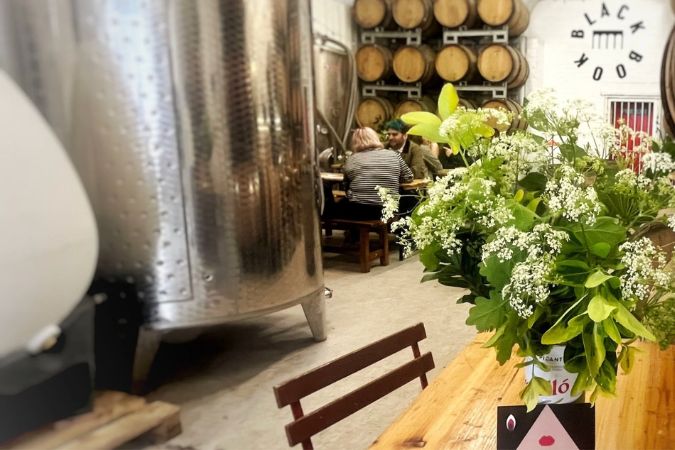
Blackbook Winery, Battersea
Blackbook Winery in Battersea was founded by Sergio and Lynsey Verrillo in 2017, a couple that planted barrels rather than vines under the archways of south London’s railway ‘Arch 41’. Their mission has always been to make exceptional still English wine. Blackbook’s grapes, traffic permitting, come from a two-hour radius of the winery – single vineyard and single-clone specific – from growers with whom they have long-standing relationships. ‘While we’re seeing amazing results from certain pockets of the UK, we still don’t know which sites will be best in years to come. That’s the beauty of being able to work this way’, says Sergio, under his ‘pragmatic rather than dogmatic’ ethos of ‘showcasing the best of English terroir’ and not releasing anything without at least a year of age. The accolades that decorate Verrillo’s wines prove testament to the approach.
The Blackbook wine bar is open for Summer 2026, Fridays 4-9pm and Saturdays 5:30-9:30pm. Tours and tastings run on a Saturday and can be booked via the website. blackbookwinery.com/visit
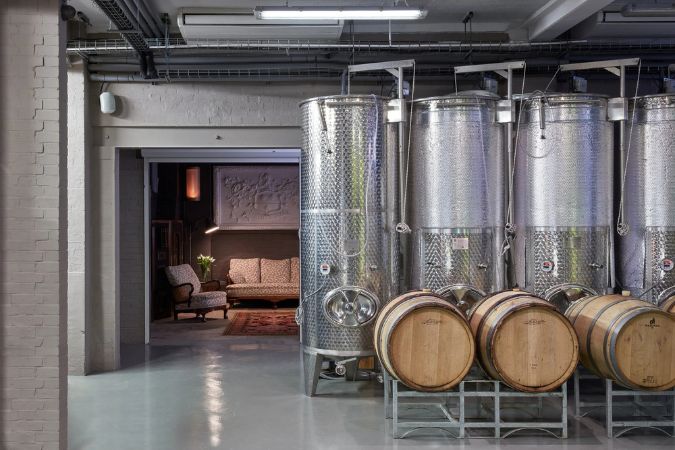
London Cru, Fulham
Now fully owned by Roberson, Melbourne-born winemaker Alex Hurley took over the reins at London Cru in 2018. The winery is housed in a former gin distillery that has grown to include three Italian concrete tanks that form the basis of the red wine programme. Since 2017 the winemaking has evolved to an offering that is English-grown only. As a trained exploration geologist, Hurley is mad on soil, vineyard site and its influence on the resulting wines, which drives his overall philosophy. In 2023, Cliff Roberson acquired ‘Foxhole’, their own vineyard of 6.5ha in West Sussex, 45 minutes’ drive from the winery. This ensures full control from vine to wine, and an amplified focus on sustainability and minimising carbon footprint.
Traditional method sparkling and still ‘culinary’ wines make up London Cru’s focus alongside a more playful Col Fondo that Hurley – who also worked at Gusbourne in Kent – and asssistant winemaker Sarah Wright both enjoy making. ‘Summer is always an adventure. If [the vintage] is like 2024 it’s an opportunity to be creative,’ she adds, saying: ‘I love that the English weather keeps us guessing, but it keeps us agile. It allows us to experiment and throw things at the wall. To play around a bit. The weather is always saying “don’t get too comfy”.’
Yoga & Wine sessions run throughout June for £45, or book a tour (£28) or a ‘winemaker for a day’ course for £170. londoncru.co.uk/whatson
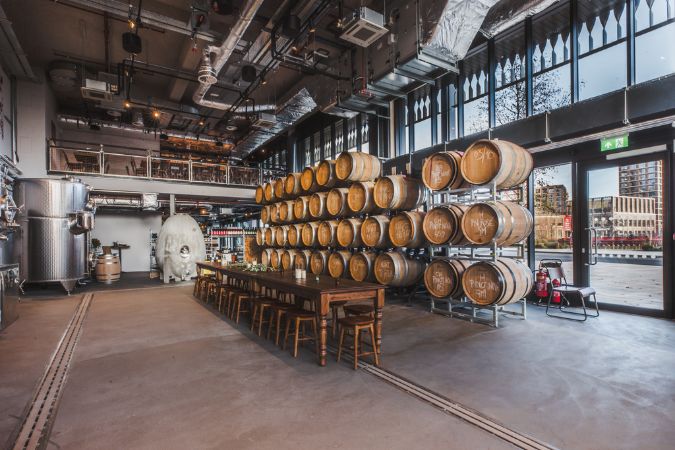
Vagabond, Canada Water
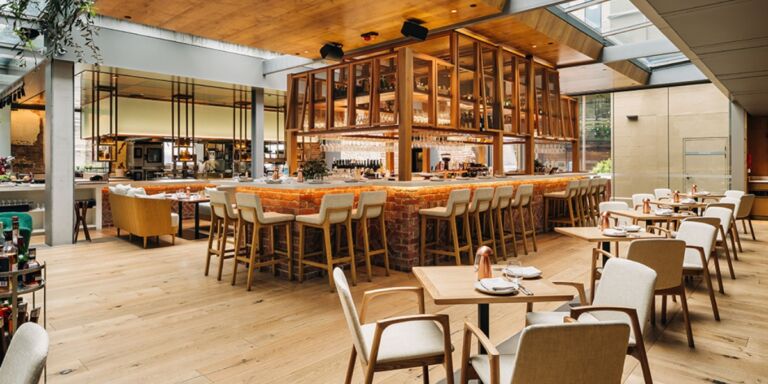
Vagabond’s new 6,000sq.ft space boasts shiny new technology, concrete eggs, a barrel room and space for more machine-led manoeuvres. Winemaker José Quintana started at the Battersea site during Covid in 2021, an impressive two weeks before harvest.
‘This isn’t an opportunity to just mechanise everything. We’ll still foot-tread,’ he says. ‘Wine production is not just a spreadsheet business. It’s a slightly “belief-vision” business too,’ he adds, while describing how they have grown from five to ten labels and how their longer term goal is to produce five times as much wine in the next four years. ‘It’s great to see a vision come to fruition,’ says new owner and Majestic CEO John Colley, a vision also shared by British Land for the wider Canada Water area, whose ambition is to develop the neighbourhood into a must-visit destination over the next 15-20 years.
Tastings and experiences happen year-round, from cheese and wine matching, WSET courses and wine blending masterclasses. vagabondwines.co.uk
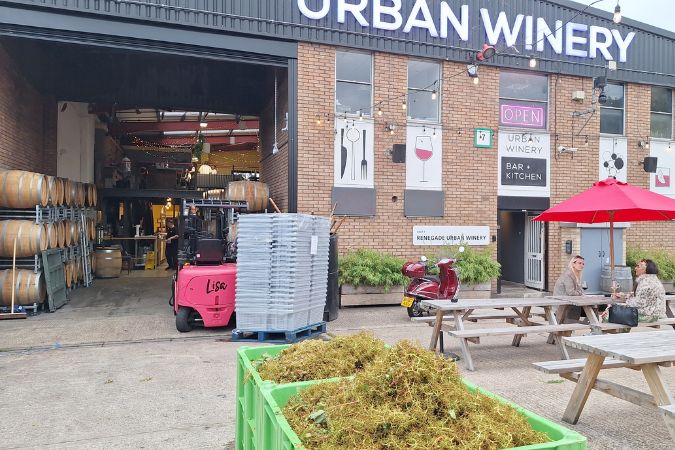
Renegade, Walthamstow
Renegade Winery was founded in 2016 by former ‘financial services guy’ Warwick Smith at age 35. ‘I thought, “I could get stuck in this [finance] thing for the next 20 years. It’s now or never to try something different”.’ Smith took his inspiration from the urban wineries in the US – like Bow and Arrow in Brooklyn and Infinite Monkey Theory in Denver – ‘they had a cellar-door, craft-brewery approach to letting people in’. Ten years on, the winery has moved from its original premises in Bethnal Green, where a Renegade bar still thrives under GM Greg, popular with east London wine enthusiasts as well as those more traditionally discerning (apparently the 67 Pall Mall team had their Christmas party here). Renegade’s production facilities and event spaces now sit on a food-focused industrial estate in Walthamstow.
Smith tells me it’s been a challenging nine years: ‘I didn’t know what wines I wanted to make so our style has changed a bit over the last ten vintages.’ They have gone from using 70% European grapes to 100% English ones: ‘We’ve changed tact to make interesting, innovative wines,’ says Smith, adding ‘if we can make wines that are not easily comparable then we can hold a niche and get ourselves on the map for something interesting.’ Each of Renegade’s wines bear the faces of their customers – ‘Karen’ for example works for TFL and lives in Walthamstow with her wife. Perhaps most recognisable of the range is the Roger the Rondo Col Fondo, a sparkling dark red wine made from grapes grown in Hampshire.
Live music nights, ‘Pinot and Bambino’ and event and wedding hire available. The Renegade small plates kitchen is open Thursday: 5pm – 11pm, Fridays & Saturdays: 12pm – 11pm, Sunday: 12pm – 6pm renegadelondonwine.com