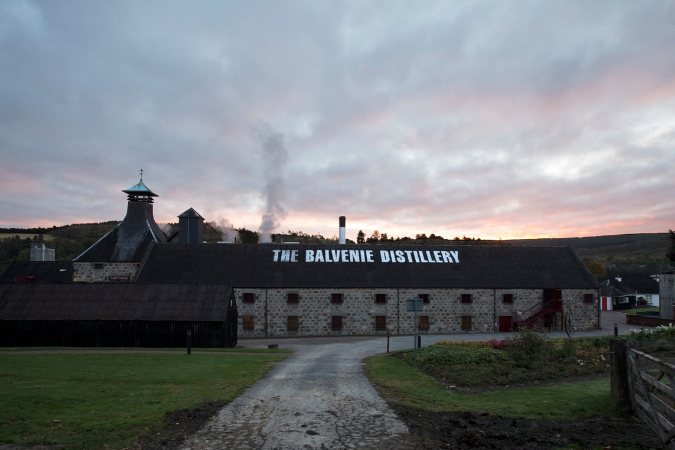
Sometimes it pays to have a big family. With the help of his wife Elizabeth and their nine children, entrepreneur William Grant built the Glenfiddich distillery in the burgh of Dufftown in northeast Scotland. With a vision to make the best dram in the valley, the first drops of whisky flowed through his Speyside stills on Christmas Day in 1887. Five years later, Grant opened a second distillery, The Balvenie, specialising in handcrafted single malts, and in 1898 the first bottles of Grant’s whisky were released in its now iconic triangular-shaped bottle.
Spearheaded by Grant’s son-in-law Charles Gordon, in 1909 the company opened up its business to global exports, and in 1963 Glenfiddich changed the game with the international release of its straight malt. The first official single malt Scotch to be sold outside of Scotland, Glenfiddich created the single-malt category at a time when blends were the norm. By the late ‘60s it had become the world’s best-selling single malt and it remains one of the most widely distributed, enjoying a significant share of the global market.
Human intuition and instinct teach you far more than data ever could
Today, the wider William Grant & Sons company – the highest-scoring producer in the inaugural IWSC Top 50: Spirits list – has distilling and bottling operations in Scotland, Ireland, Iceland, India, the US and Mexico; a workforce of more than 2,800 employees; and a presence in 180 countries. The company remains independent and family-owned, with Grant’s great-great grandson, fifth-generation family member Glenn Gordon, serving as its chairman.
William Grant & Sons continues to embody the pioneering spirit of its founder. Beyond its core whisky brands, which include Irish whiskey Tullamore D.E.W, Monkey Shoulder – a blended malt made for mixing – and Scotch whisky liqueur Drambuie, the William Grant & Sons portfolio includes Hendrick’s Gin, which is still overseen by its original master distiller Lesley Gracie; Sailor Jerry Rum; Reyka Vodka; and ultra-low alcohol spirit Atopia, which launched in 2019.
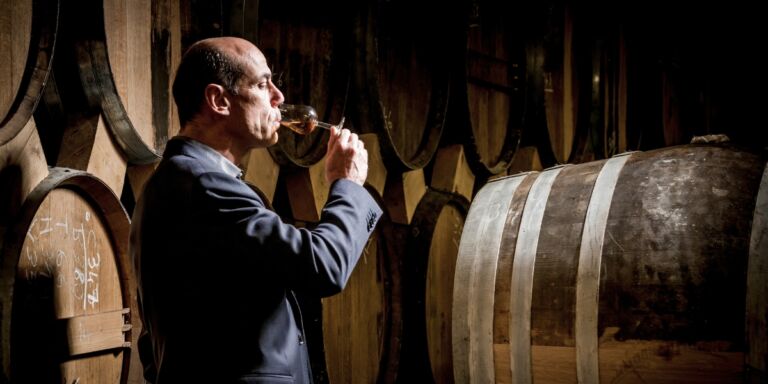
Brian Kinsman is in charge of the blending operation across the entire William Grant & Sons portfolio. Having joined as a lab chemist in 1997, during his 28 years with the firm he’s nosed over 250,000 whisky casks to ensure consistency in flavour and quality, and was the brains behind the reimagining of Grant’s and the creation of Monkey Shoulder in 2005. Having served as Glenfiddich’s master blender since 2009, during his 16-year tenure he’s been responsible for creating a host of highly successful limited edition expressions. For Kinsman, blending is more of an art than a science. ‘The science gives us the foundation but you have to trust your senses,’ he says. ‘You’re judging balance, texture and character by feel: human intuition and instinct teach you far more than data ever could.’
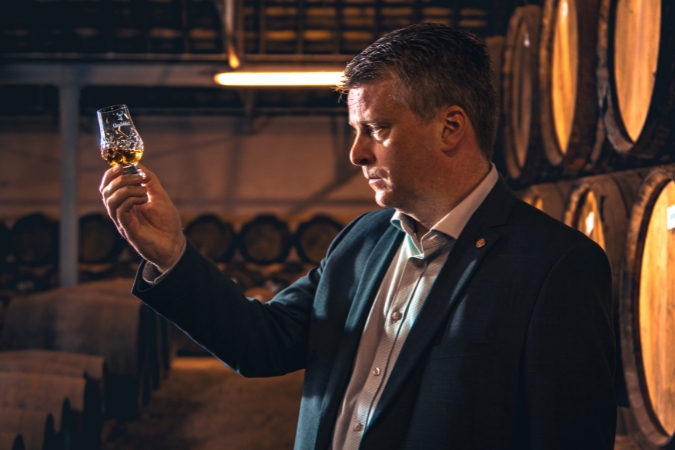
While consistency is the aim of the game, the goal isn’t for every cask to taste the same. ‘Consistency doesn’t mean uniformity, it’s about balance,’ Kinsman says. ‘Casks mature slightly differently and our job is to work with those natural variations rather than against them. We sample thousands of casks every year and then we select, vat, and let them marry for months until the character feels seamless. Each batch tells the same story in a slightly new way. That’s the sweet spot.’
Glenfiddich did exceptionally well at this year’s IWSC awards, scooping five gold medals, with its 15 Year Old Solera Single Malt and Perpetual Collection Vat 01 Single Malt receiving 96 points. Scoring even higher were its 30 Year Old Suspended Time limited edition and 31 Year Old Grand Château Single Malt, which scored 98 points. In addition to trusting his intuition, time plays a crucial role for Kinsman when it comes to crafting quality liquid. ‘Timing is everything, but it’s not an exact science,’ he says. ‘Over time you learn to read a cask. Sometimes a whisky reaches perfect harmony at 18 years and sometimes it needs 30. You’re looking for the point where the cask and spirit are in balance, where one doesn’t overpower the other. If you wait too long you can lose vitality; too early and the whisky won’t have depth. It’s a decision that’s part science and part instinct.’
With cask finishes continuing to prove popular, Kinsman has worked with everything from Bordeaux wine and amontillado Sherry barrels to Japanese awamori casks, all of which bring something different to the table. ‘Cask finishing is a way to add another layer of personality to the whisky, not to disguise it,’ he says. ‘Each cask type brings something unique: Bordeaux adds ripe fruit and warmth, amontillado brings nuttiness and dryness, and awamori gives a lovely textural richness and exotic sweetness. The key is balance. You want the Glenfiddich character to still shine through. When it’s right, the finish feels like a conversation between the spirit and the wood.’
For Kinsman, it’s the balance of innovation and heritage that makes William Grant & Sons stand out in a competitive market. ‘We’re not afraid to experiment but never at the expense of quality or consistency,’ he says, describing the feeling of being named number one in the IWSC Top 50: Spirits as a proud moment for the whole team. ‘These awards acknowledge the collective effort that goes into every bottle and to be recognised by the IWSC against some of the best in the world is a validation of that shared commitment to quality,’ he says. ‘It reminds us why we do what we do: strive to make whiskies that stand the test of time and make the people behind them proud.’