The Canaries are those seven islands off the north-west coast of Africa beloved of northern Europeans seeking the certainty of sunshine even in winter. Given that they are only about 100 kilometres from the coast of southern Morocco it might seem they have little Spanish about them. Nevertheless, they were acquired for the Spanish crown in the fifteenth century and have remained strategically important ever since. There are inevitable cultural and linguistic differences from the mainland. Some foodstuffs are different too. Savour the bananas, which are exceptionally banana flavoured. Be surprised by the papas antiguas, the small, round, colourful potatoes with their own denomination of origin, which were brought from the Americas four centuries ago. Don’t forget the wines.
The islands were known to the Romans. Ferrán Centelles says that the Roman Pliny the Elder wrote of an island that was called Canaria because of its large dogs, canis in Latin. Much later, London’s Canary Wharf, now a financial services hub, was named after all the products that came into the docks from the major trading centre of the Canaries, especially the wine known as Canary sack. Today’s Canary wines have become fashionable very rapidly. This has been driven partly by the style – lighter and fresher than they used to be, not weighed down with oak, generally lighter in tannin and in alcohol. Another driver has been interest in the varieties – many hardly known on the mainland, and with different flavours. The people have also made the difference; an energetic new generation led, at least in the UK market, by Jonatán García of Suertes del Marqués in Tenerife, whose 2011 vintage was so well received. Tenerife, and the Canary Islands, are now on the radar of every serious sommelier, thanks in part to its diverse and young soils.
Spain but closer to Africa
The islands were created by a series of underwater eruptions. As the eruptions occurred at different times, the island soils are of different ages. It is easiest to understand the islands by dividing the archipelago into two. The western section takes in El Hierro, La Palma, La Gomera and Tenerife; the eastern section is Gran Canaria, Fuerteventura, Lanzarote and the islands of the Chinijo archipelago. These two parts are separated by a tectonic fault. The eastern islands are much older, so have had more time to be eroded, which explains the different landscapes. Lanzarote and Fuerteventura, for instance, are notably lower in altitude. By contrast, the western islands are much younger, and still prone to eruptions (witness the 2021 eruption on La Palma). They have not yet had time to be eroded. In the centre are Tenerife and Gran Canaria, which have not yet been greatly eroded.
The largest islands are Tenerife and Lanzarote. The highest peak in the Canaries is Mount Teide in Tenerife, at 3,718 metres. La Palma has the second highest peak, the Roque de los Muchachos at 2,426 metres, and Gran Canaria the third highest at 1,949 metres, Pico de las Nieves. Growing vines on these mountain slopes is invaluable for making fresher wines. The islands differ in climate too. Notably the northern side of the islands is generally greener and lusher because of the humidity from the Atlantic, and the trade winds. By contrast the opposite side is much drier. Driving around Tenerife, the contrast in landscape up and down the slopes is obvious. At around sea level the climate and the vegetation are clearly subtropical. Up to 700 metres the climate is more temperate, and above 700 metres there is much more diurnal contrast in temperature. One island can produce a number of styles. Perhaps Tenerife, with its five DOs in one island, is more explicable to an outsider after all.
The climate and the terroirs, along with the varieties adapted to their sites, give these wines a distinct character. The wines can have a reductive character, with a note of flint or struck match. This is sometimes said to be a directly volcanic flavour. However, most winemakers put it down to stressed yeasts in fermentation as a result of poor nutrition in the soils.
Producers can opt to sell their wines under the Islas Canarias/Canary Wine label rather than a more specific DO. There’s an advantage: Canary Wine has a very clear pyramid of quality. At the foot of the pyramid is the generic ‘Canary Wine’. Next up are the Island wines: ‘Canary Wine/Tenerife’. Then there is town or village wine: ‘Canary Wine/Fuerteventura/La Oliva’. The pinnacle of the pyramid is the parcel wine: ‘Canary Wine/Fuerteventura/La Oliva/Vinode la Parcela de Lajares’. For any foreign consumer this labelling is clear signposting to the intention of the winemaker, and to the quality of the wine. All the islands grow vines and make some wine but perhaps the two currently most interesting to wine lovers are Lanzarote and Tenerife.
Lanzarote
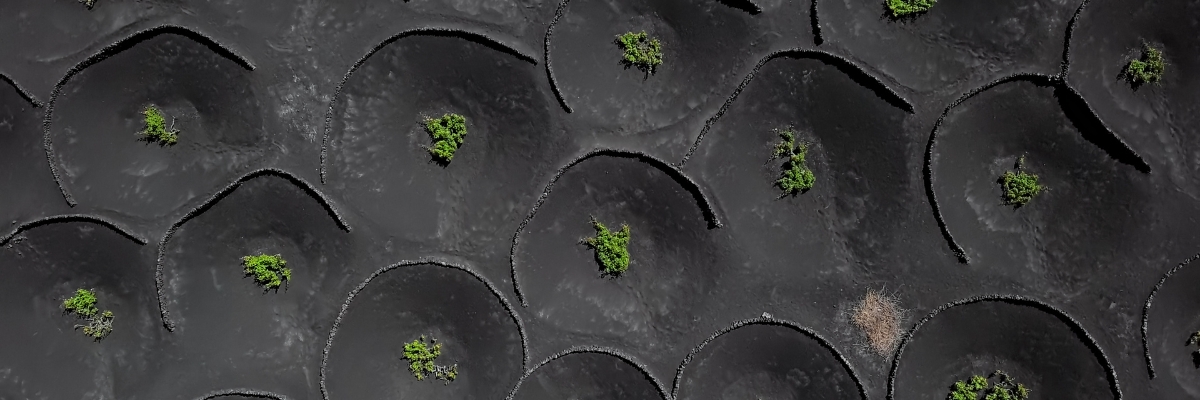
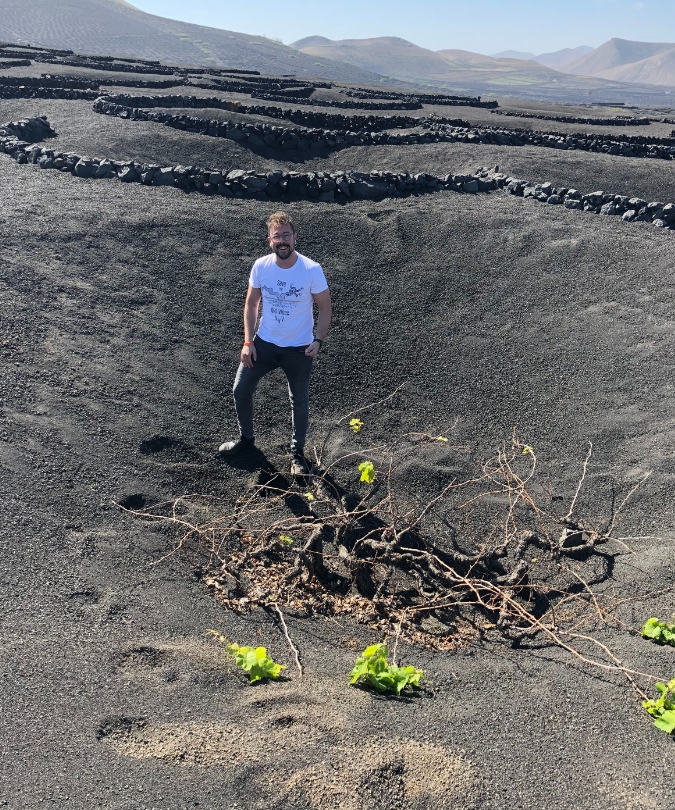
Lanzarote is catnip for the wine world, with its extraordinary vines tucked into shallow basins in the black volcanic soil. These are set off by the white-painted buildings scattered across the landscape, a design implemented for the island by the artist César Manrique. The La Geria district (and part of La Palma) has the distinct volcanic pebbles called lapilli. They take moisture from the winds (and Lanzarote, with no mountain to block the blasts, is very windy) and prevent water evaporating from the soil. Before the eruptions of 1730-36 the climate and the soil did not favour the growing of vines or other fruit, only cereals. The eruptions provoked mass emigration. However, those who stayed learned how to cultivate plants through the layer of volcanic ash, and found a way to stop the water evaporating from the soil. They did this by digging shallow craters to protect the vines from the wind, and to retain every drop of moisture. Nevertheless, it remains a harsh environment. The winds blow endlessly across the island and it only rains on average 35 days a year.
Tenerife
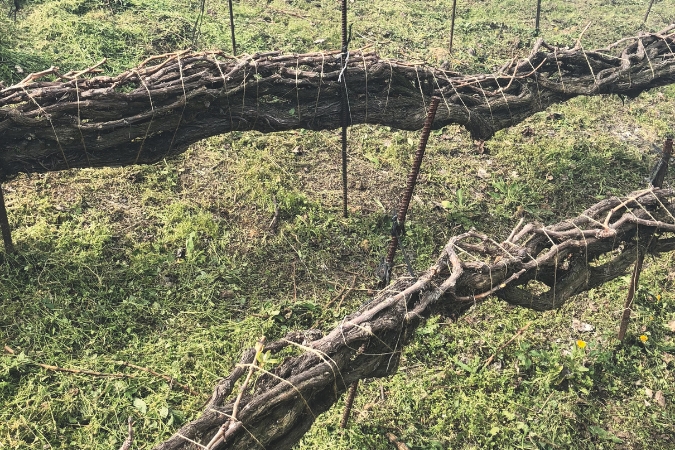
Tenerife is sandwiched between the Sahara and the Atlantic, with very different aspects from one side of the island to the other. It is home to five DOs: Abona, Tacoronte-Acentejo, Vallede Güímar, Valle de la Orotava, Ycoden-Daute-Isora. While understandable, a single Tenerife DO would surely be welcome to consumers. If you have not yet been to the island, I advise you to make a visit simply in order to see the traditional method of training vines in the steep Orotava Valley. Forget about sunbathing, or climbing up Mount Teide, these vines are extraordinary. The method used is cordon trenzado, meaning a twisted rope. The vine stem grows about half a metre from the ground, halfway up a slope. Then it is pruned so that half its canes grow down the slope and half upwards. The canes are bundled together as they grow and supported at intervals on stakes at a height of 0.5 metres. It is tremendously laborious work.