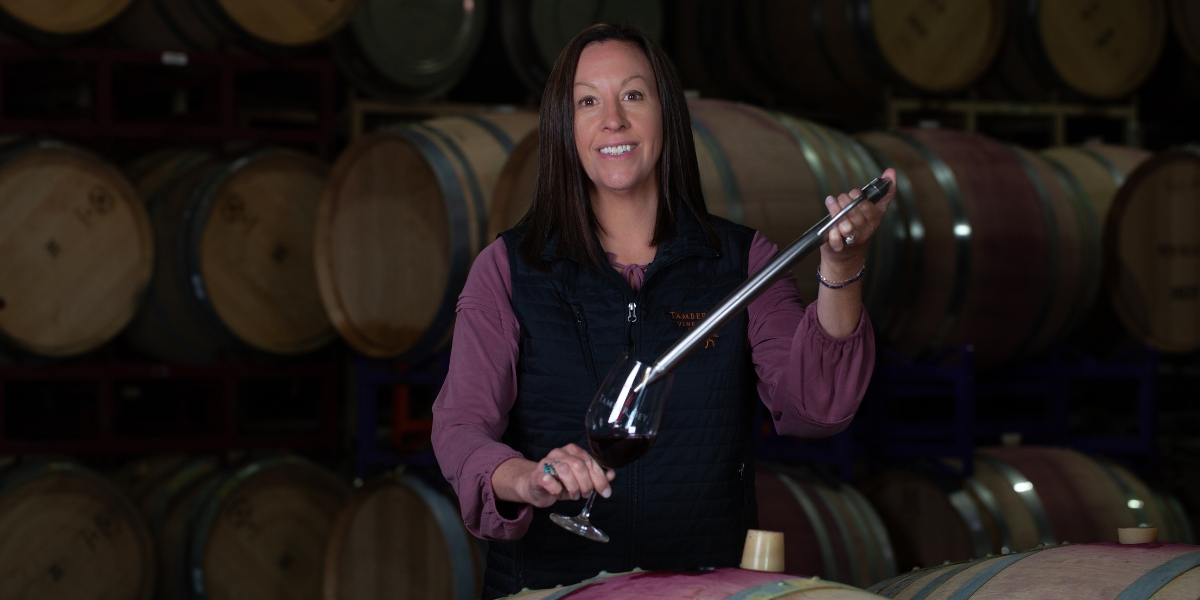
Sally Johnson Blum prefers to call herself a contractor rather than a consultant. ‘Even though contractor’s a horrible word,’ she says with a laugh. She’s also (and this is official) one of Glamour magazine’s ‘10 Most Badass Women Winemakers’ in the US.
Johnson Blum works for some eight wineries in Napa, Sonoma and in Washington State’s Walla Walla. She’s resident winemaker at Tamber Bey in Calistoga; owner Barry Waitte is delighted to let her use the winery for her freelance operations. While she’s far from a celebrity like Michel Rolland or Philippe Melka, nor a cultish figure like Heidi Barrett or Helen Turley, Napa-watchers describe her as a name to know.
She was eight years at St Francis winery in Sonoma and 15 years at the highly regarded Pride Mountain Vineyards on Napa’s Spring Mountain. Her Pride Mountain wines attracted attention; Robert Parker gave 100 points to the 2012 and 2013 vintages of Reserve Cabernet Sauvignon, and several wines featured in Wine Spectator’s coveted ‘Top 100’ list. She then joined Robert Mondavi Winery as director of winemaking, when San Francisco Chronicle called her ‘one of Napa Valley’s most well-respected winemakers’. More on Mondavi later.
So. ‘Badass’. What exactly does that mean? ‘It’s a very marketable little soundbite that can get me a lot of attention,’ Johnson Blum replies. She’s obviously not in the least put out by it (who would be?). What does she think of the ‘women winemakers’ label? ‘I don’t like binary dichotomies. I think life is a lot more complex than that. So, I would never say women make better wine than men, for example.’
Johnson Blum has first-hand experience of the complexities of life. Until 2022, her career trajectory seemed pretty stable. She grew up in a family of scientists – her father is a toxicologist, her mother was VP of drug development for Pfizer, her brothers are scientists. Her first degree was in French literature and biology, and she did a masters in winemaking at UC Davis. She was established and comfortable at Pride. Then, in 2022, Mondavi offered her the position of director of winemaking and it all went pear-shaped.
A lot of what she tells me is off-record but the gist of it is that she and the corporate world (Mondavi is part of the huge Constellation group) didn’t get on, and she left in a matter of months. It was, she said, ‘a very stressful experience’. She reveres the legacy of Mondavi but found she ‘didn’t even speak the language’ of Constellation. Though she has ‘nothing but good to say’ about the teams she was working with, she found herself immersed in KPIs and spreadsheets instead of the ‘hands-on winemaking’ that was her lifeblood.
I was so far out of my comfort zone I had to reinvent myself
To paraphrase the well-known saying: Some people reinvent themselves, others have reinvention thrust upon them. Johnson Blum is one of the latter. A naturally cautious person, she says she loved working at Pride, ‘above the fog line’, and she would never have left to go out on her own but Mondavi was a dream job – ‘it was described as returning Robert Mondavi Winery to its rightful place as the heart and soul of Napa Valley.’ It didn’t work out and she found herself without a job. ‘I was so far out of my comfort zone I had to reinvent myself. But it’s pretty cool to be unleashed.’
She now makes wine for some half-dozen boutique operations in Napa and two in Walla Walla; in 2023, she launched Stereograph with her husband Max Blum, an antique dealer, graphic designer and sometime thrash metal guitarist (‘He’s the most interesting man on earth,’ she says matter-of-factly).
This year, Stereograph stood out at the two big annual Napa Valley auctions. At the trade-facing Premiere Napa Valley in February, five cases of 2023 Oakville Cabernet Sauvignon fetched $10,000 (or $167 per bottle). Considering their ‘entirely new’ brand was showing alongside such icons as Cain, Harlan’s The Mascot, BV, Darioush, Quintessa and dozens of other names, Johnson Blum said she was thrilled with the result. In June, at Auction Napa Valley (a charity auction that attracts serious collectors and big bidders) her ten cases went for $9,900 in total.
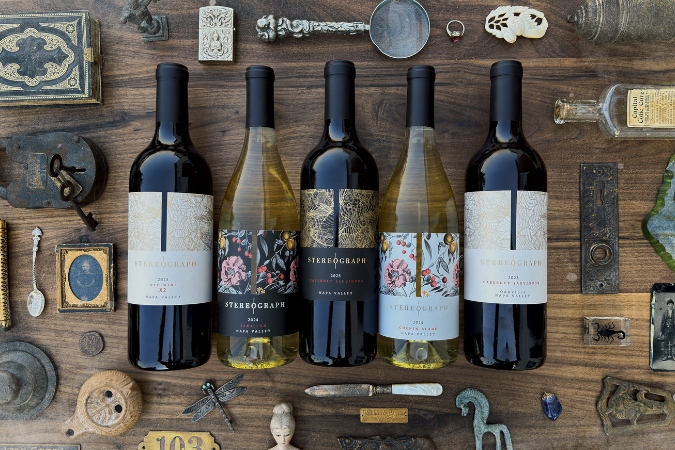
Johnson Blum’s mission is to show the diversity that Napa is capable of, to demonstrate the amazing variety of its soils, the complexity of its weather patterns – and to do it in a way that makes it accessible. Stereograph, a 350-case operation (Max designs the labels, which are gorgeous) ranges from a Carneros Sauvignon Blanc via Oakville Cabernet, a Merlot-Cabernet from Chiles Valley and Oak Knoll, and (one of my favourites) a Chenin Blanc from the 80-year-old vines at Henry Ranch vineyard in Pope Valley, the other side of Howell Mountain on the east side of the valley. This year they’re getting ‘some Fiano from a really cool regenerative organic in Rutherford.’ She says she and her clients are ‘pushing the envelope in terms of organic, regenerative, organic, biodynamic. [Operations that are] really trying to farm conscientiously.’
The Chenin, a honeyed, textured wine with fine acidity, is a lovely expression of this complex grape. Most importantly it’s priced at $60 a bottle. Stereograph wines are all under $130 – the excellent Carneros Semillon is $40 – ‘I’m trying to be accessible in my price points,’ Johnson Blum says, noting that ‘people are really annoyed by Napa prices.’
She also believes that Napa is at a crossroads. ‘I think we’re at a critical moment where we either aspire to become Burgundy and have specific, micro-plots of very special wines owned by families, cared for by families, passed down to families. Or we get acquired by corporations and maybe go more of the Bordeaux route, where there are huge vineyards and more uniformity of style.’ She’s in no doubt which way she would like it to go, ‘but that’s going to be harder because there’s too much money in it. A vineyard in Yountville just sold for $500,000 an acre. It’s hard to say no to that if you’re the third generation.’
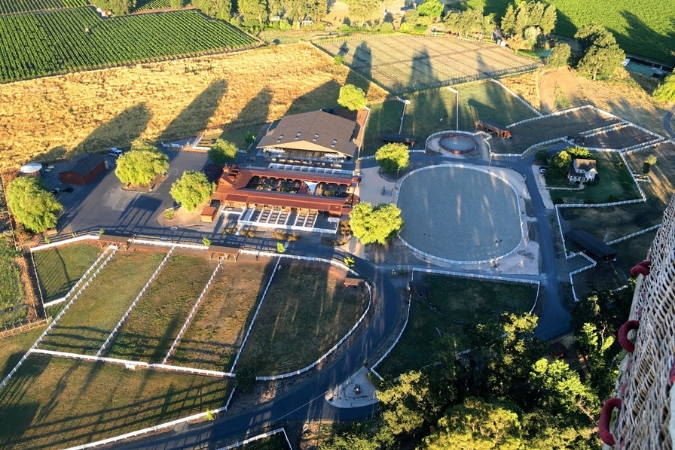
Sitting opposite her at Tamber Bey, which is part winery, part horse ranch (you can join their ‘Eqwine Club’), Johnon Blum comes across as a calm and humorous presence. Indeed, she says comedy is one of her skills – ‘not like stand-up, telling jokes; more wry and sarcastic’. Her attitude to winemaking is bracingly unpretentious: ‘A wine starts with grapes, it ferments, and then it goes into a container; at some point it’s opened and consumed. So for me, it’s a craft, like ceramics or baskets.’
People are really annoyed by Napa prices
Unpretentious but by no means simplistic. For Stereograph, the grapes are sourced from some of the most interesting terroirs and vineyards – like the Henry Ranch old-vine Chenin and Oak Knoll’s Merlot-dominant Blackbird Vineyard. She ferments the Chenin in a ceramic globe – ‘it’s more anaerobic than concrete but it’s not as anaerobic as stainless’. She spends a lot of time thinking about ‘how to make distinct, unique wines for each client’ while at the same time putting something of herself into the wine. As she says, ‘these are wines that represent me, I guess.’
This is not to suggest the wines should shout of their winemaker but that the winemaker is as intrinsic a part of terroir as the soil and the sky. ‘I make probably 10,000 decisions for every wine that I bottle, all the way through the growing season, to the day of harvest, to every single day [in the winery], how to manage the fermentation, the oak, the yeast, when to bottle, what the blend is…’
She is a resolutely democratic vigneron. Wine is like music, she says: the more the better. ‘If you love music, you’re going to want to listen to every style. If you love wine, you’re interested in every region in the world. The best thing I can do is try to make great wines and communicate what I think is so special about them. Let people taste them and hopefully they will love them as much as I do.’