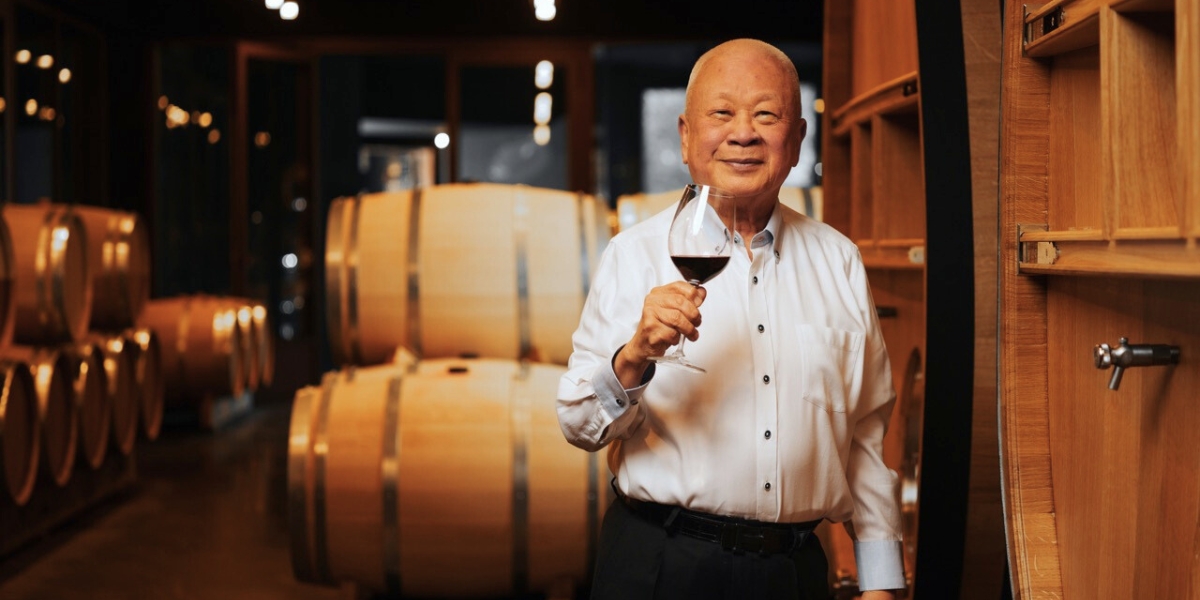
Peter Kwok uses the word ‘invest’ a lot and he’s not always talking about money. I get the impression that the most important investments he has made since he left Vietnam at the age of 17 are in himself.
‘Since I was 17 or 18, I always had a 10-year plan, a 20-year plan,’ he tells me when we meet at Château Bellefont-Belcier in Saint-Émilion. ‘Not that I know what I will be, but I think [about] what I want to do. When I was at school, anything I think is related to achieve that; I make the extra effort, pick the right courses, invest more so that I can get there. And if you start to have more resources, you invest more. When you invest more, you learn more.’
When you invest more, you learn more
Bellefont-Belcier is the flagship property of Kwok’s Vignobles K, which owns seven Bordeaux estates as well as two luxury hotels in Tibet and Xi’an in China. Kwok, 73, sits alertly on the sofa holding a silver-topped cane. Small in stature, dressed in comfortable-looking black linen, he’s cheerfully welcoming and businesslike on this May morning.
He’s a considerable (if low-key) figure in Bordeaux and a titan in the world of high-end Chinese art. His collection of Ming dynasty bronze and gold, the Dong Bo Zhai Collection, is the centrepiece of the Qujiang Museum of Fine Arts in Xi’an, of which he is the founder and owner. His collections span the Ming, Song and Qing dynasties and the Warring States Period from 476 to 221 BCE. There are also Dutch old masters, French impressionists and Picasso ceramics. He’s made numerous loans and donations to French museums and in 2019 he was awarded France’s highest accolade, the Legion d’Honneur.
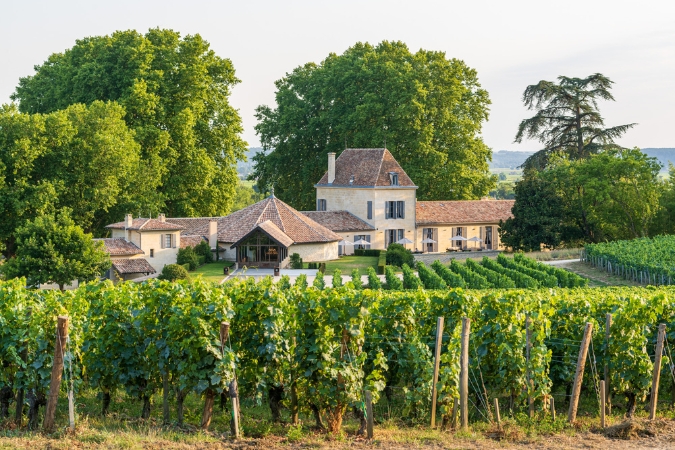
Having made his fortune in banking and canny investments, and as chair of a major division of the huge Chinese group CITIC (he left in 2007), his first purchase in Bordeaux was Château Haut-Brisson in 1997 – bought, as he tells it, on a whim. He wanted somewhere in France to spend the holidays. He looked around in Paris but saw nothing he liked, then a colleague suggested Bordeaux, ‘and someone introduced me to Haut Brisson, and I bought it.’
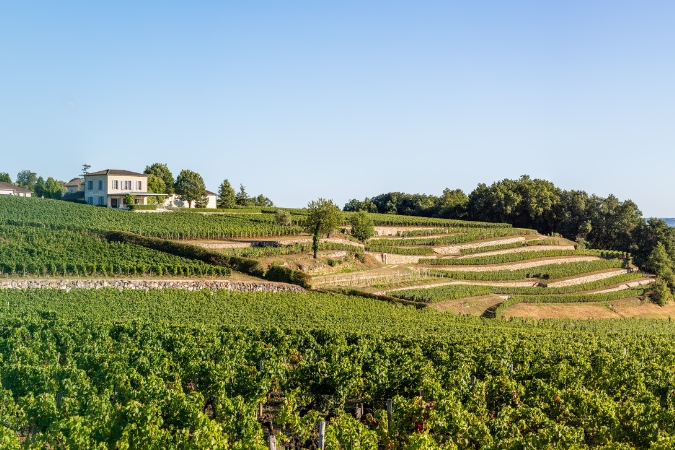
It wasn’t as simple as that, of course – there was a deal to be made – ‘You know, it had been on the market for six months, so I said I wanted a 10% discount.’ He laughs. That was refused, no one contacted him for a month, he called up, found it was still on the market. ‘So I said “ok, I’ll give you a 10% deposit.” That’s how it ended up.’ Since then, there has been a series of acquisitions, including some very boutique properties: La Patache and Enclos Tourmaline in Pomerol, Enclos de Viaud in Lalande-de-Pomerol, Château Le Rey in Castillon Côtes de Bordeaux and the Saint-Émilion estates Bellefont-Belcier and Tour Saint Christophe. The latter is remarkable for its 18th century dry-stone-wall terraces, which Kwok has painstakingly restored.
He had no intention of making wine, at first. He wanted ‘a family home’ and to bring up his children surrounded by French culture. (Elaine, Howard and Karen now own the properties and Howard manages investments for Vignobles K). In wine matters, Kwok defers to his right-hand man and partner Jean-Christophe Meyrou, who oversees all the estates, but there is no doubt how seriously he takes his vineyards. His senior staff throughout, for example, are a roll-call of Bordeaux talent and experience.
Kwok was born in Saigon (now Ho Chi Minh City) in 1949. His parents were members of the Chinese community that has been established in Vietnam for centuries. His father sold Chinese medicine and they lived modestly above the shop in Saigon’s District Five, Chinatown. The young Peter (as he tells it) was imbued with the glories of France. ‘People told you, the coffee is better in France. Notre-Dame of Saigon is not comparable with Notre-Dame in Paris. And then they said the river in Paris is ten times better. So that’s your dream.’
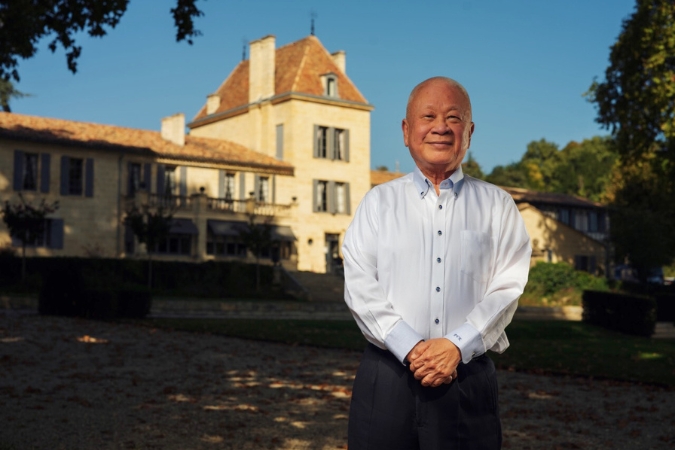
Taking advantage of the fact that Chinese nationals could get a visa to study in Taiwan or China, he left Vietnam at the age of 17 – this was the mid-1960s and the war was at its height – and took a degree at Taiwan University. He doesn’t say how he left. Later, I call Howard in Hong Kong. Wouldn’t that have been part of the family myth? ‘You know, he never talked much about it,’ Howard said.
Another thing he hasn’t talked about was being kidnapped by the Viet Cong. I’d turned my recorder off and we were getting up to go to lunch, when Kwok said, ‘You know, I was caught by the VC when I was 16. I was on my motorbike and I was stopped by a group of soldiers. They said, “Come with us to see how we live”.’ They took him to their training camp for a week and then let him go. What an extraordinary story, I say. ‘I was very scared. thought I was going to die,’ he says matter-of-factly.
On the surface, there’s nothing reticent about Peter Kwok but he manages still to seem guarded. There’s an instructive moment when he mentions he knows Jack Ma, the Alibaba billionaire who fell foul of the Chinese Communist Party and went mysteriously silent for several years. I wonder what had happened to him – did he go into exile? ‘He talked too much,’ Kwok says.
The VC story is told with a straight face, as if he’s still astonished it happened – but there are other subjects (equally serious, you’d think) that he dismisses with a laugh and a wave of his hand. We talk about Chinese heads of state he’s met. He reels them off: Hu Jintao, Jiang Zemin, Deng Xiaoping. Did he ever think about getting into politics himself? ‘No, no. It’s very dangerous. I don’t even want to talk about that. I prefer to do business.’
His first major deal was selling his Ming period ceramic collection for ten times what he paid for it. This was before 1997. ‘I paid maybe US$1.5m to buy all those. And I sold it for $25m. That was the first, the biggest deal of my life.’ He bought land in Shanghai with the proceeds and spent about $2m on Haut Brisson. ‘For me, that was real cash,’ he says with another laugh.
Kwok only does something if he can do it very well indeed. ‘I’m not interested in buying a First Growth. But what I do with my resources, I buy the best thing I can buy.’ Then he builds a team – starting with the quietly efficient Meyrou – to make a wine that ‘when people drink it, they can guess, this is from Belfont-Belcier, or ah, this is most like Tour Saint Christophe.’
I think of the boy riding his bike past the fine French villas in Saigon and comparing them with their counterparts in Paris. And now he’s at the heart of French culture, knowing that the best wine he can make isn’t the most expensive or the most famous but the most authentic: the wine that is of its place. This is the skill of the artisan. Anyone can make a blockbuster wine but only the very skilled winemaker can express terroir in the glass.
I’m not interested in buying a First Growth. But what I do with my resources, I buy the best thing I can buy.
Are there plans to buy more properties, I ask Howard on the phone. ‘Right now, the important thing is to make wine that we are really, really proud of. If the right property came up, then of course we would consider it, but it would have to be Bordeaux, of course.’
As we finish our interview, Kwok tells me about another ambition. On his phone he shows me a picture of a lively-looking street in Ho Chi Minh City, a jumble of shops with houses – a cheerful, colourful scene. ‘That’s the house I grew up in.’ He’s going to buy it back and its neighbour. What will he do with it? Kwok puffs out his cheeks and thinks for a long moment. ‘Maybe rebuild it so we’ll all be more comfortable.’ It seems a worthy investment.