Hear the words ‘Italian sparkling wine’ and what springs to mind? In my teens I would have shouted back the words ‘Lambrini’ (a cheap perry which isn’t Italian at all), before upgrading to the widely-sipped Prosecco in my early twenties, and eventually settling on the foaming reds known as Lambrusco upon moving to east London on the cusp of turning 30. But never would I ever have stumbled across the word Franciacorta.
While UK consumers are heavily acquainted with Italy’s use of the Charmat method thanks to easy-drinking Prosecco DOC (DOCG examples continue to fight for recognition), the traditional-method long-aged Franciacorta of Italy’s Lombardy region remains one of the drink industry’s best kept secrets. And with only 11% of all 20 million bottles of Franciacorta produced leaving Italy, it’s not surprising to see why.
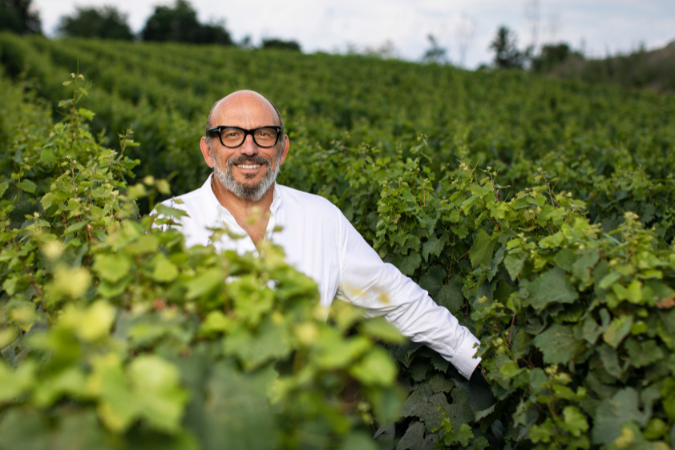
‘In Italy we [often used to] think that something that comes from the outside is better,’ says Maurizio Zanella, founder and chairman of leading Franciacorta estate Ca’ del Bosco, and in the early days of Franciacorta production this may have rung true. While Franciacorta has a winemaking history that can be dated as far back as the Middle Ages, the sparkling wine as we know it today was first conceived in 1961 at Guido Berlucchi estate. Upon returning from Champagne, Berlucchi’s winemaker Franco Ziliano was intent on making sparkling wine ‘in the French style’, creating the first traditional method wine to come out of the region. Fast forward to today, and Franciacorta has moved beyond emulating the French style: there’s a pride among winemakers in the region to reflect the topography and history of the land in every step of the process.
In 1972, the first vintage of Ca’ del Bosco was produced with Maurizio Zanella at the helm: he was just 16 years old
Purchased in 1965, the Ca’ del Bosco estate had humble beginnings as a family home for the Zanellas. For Maurizio, the estate’s neighbouring lands were ideal for whiling away days on his motorbike, with the 134 zones of Franciacorta in the vast Lombardian countryside forming the perfect backdrop for long excursions. He had little care for engaging in the viticulture that was slowly starting to increase across the region, but his attention was eventually piqued when he learned that winemaking would earn him a quick ticket to France. A party boy at heart, Zanella headed off to Paris for a sprinkling of joie-de-vivre but returned to Italy under the wistful spell of the caves of Champagne and with the aim of turning his family’s land into a successful winemaking estate. In 1972, the first vintage of Ca’ del Bosco was produced with Maurizio Zanella at the helm: he was just 16 years old.
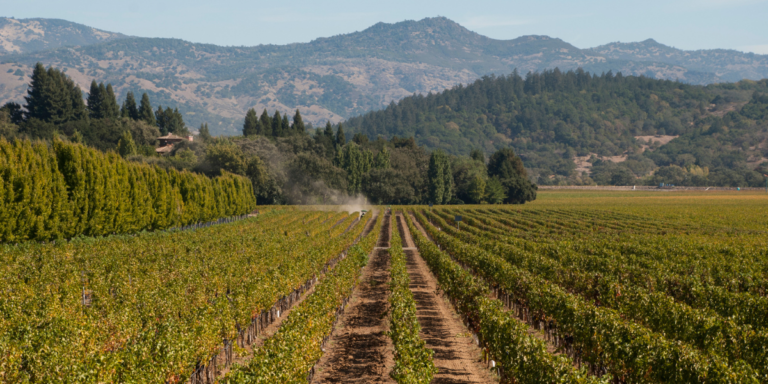
While the history of Franciacorta is often linked to Champagne, the wine produced today is far from a pastiche. Distinct terroir sets the wines apart from their European counterparts, where the grapes remain influenced by the gentle winds from Lake Iseo and the vines lie under the dark shadow of the Lombardy Alps. The grape varieties planted comprise Chardonnay, Pinot Bianco, Pinot Nero and the indigenous white varietal, Erbamat. Meanwhile, sunny temperatures and prehistoric glacial soils mean that the wines produced here are not as acidic as those in Champagne and they feature a mineral quality that is quintessential to the region. Many of Franciacorta’s winemakers seem intent on showing the purest expression of such ripe fruit and choose to create few oxidative styles in turn.
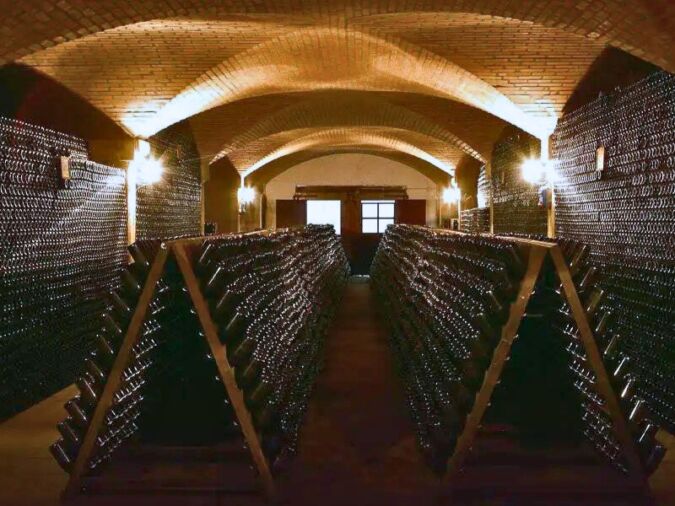
‘We believe in the grapes and where they are from,’ says Zanella. ‘Franciacorta doesn’t need sugar to be drinkable.’ Indeed, Ca’ del Bosco refuses to hide its fruit beneath any veil of additives or enhancers. This rings true for its flagship Cuvee Prestige, while at the more premium end sits the Annamaria Clementi Riserva: launched in 1988 and only created in exceptional years, it benefits from eight years of lees ageing. Both sparkling wines remain at zero dosage, while the rest of Ca’ del Bosco’s sparkling portfolio doesn’t reach any higher than 2g/l.
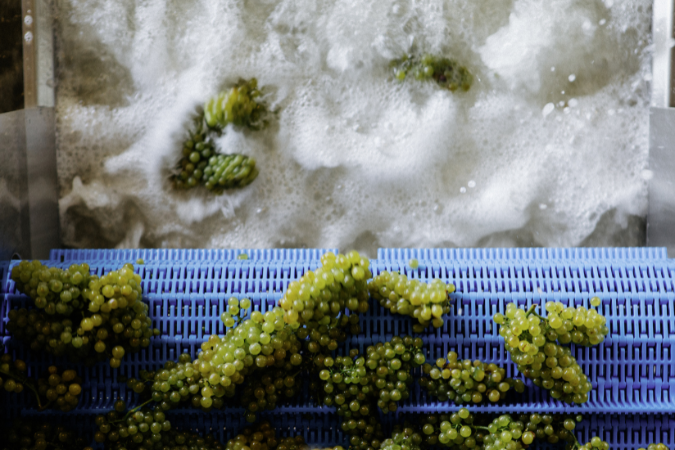
Through the invention of a Willy Wonka-esque ‘berry spa’, which the winery unveiled in 2008, the estate goes one step further in its pursuit of purity. Everything that has been harvested enters through a machine akin to a car wash, ensuring microorganisms, dust particles, pollutive matter and more is washed off the grapes ahead of maceration. ‘A lot of people think we are crazy for this, but we don’t care,’ laughs Zanella, whose critics are presumably wary of the impact on budgets, time pressures and even the risk to the organic yeasts themselves.
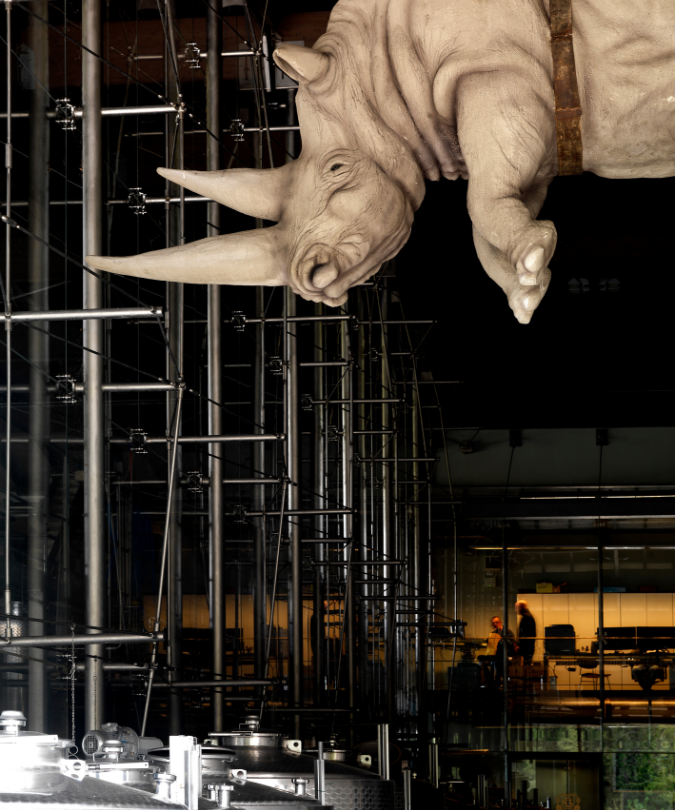
The grape spa is just one of many weird and wonderful oddities that underpin the Ca’ del Bosco estate. Walking through the winery itself is like a fever dream – on one end a huge stone rhino is suspended above the door, on another, dramatic splashes of silver encase a stainless-steel tank, and this is just inside the winemaking facility itself. As you enter Ca’ del Bosco’s grounds you’re greeted by a large pack of blue wolves, having already driven through a sculpture by renowned Italian artist Arnoldo Pomodoro, which the estate boldly cut in half (met with shock from the art world, naturally).
The Ca’ del Bosco Art Collection is as big and bold as Zanella himself. ‘It is an excuse to do something that I love, but to also valorise where we are and what we are doing with the help of art,’ Zanella explains. In 2023, the estate announced the Ca’ del Bosco Sculpture Award – a competition opened to established Italian sculptors under 40. It has become a vital tool for nurturing the next generation of Italian artists, and aims to create a dialogue between art, winemaking and the land. The recent winner of the 2026 award – Binta Diaw – has plans to create a large-scale sculpture entitled Fundamenta, which will sit on the estate’s grounds and takes its inspiration from mangrove roots. Meanwhile past winner, Irene Coppola, was inspired by the tendrils that sprout off a vine for her work handandland (2024), which is hung directly outside the winemaking facility.
Walking through the winery is like a fever dream – on one end a huge stone rhino is suspended above the door, on another, dramatic splashes of silver encase a stainless-steel tank
Ca’ del Bosco may be a playful place, but it’s serious about all that it does. Completing a five-year stint as President of the Franciacorta Consorzio, Zanella has built a career not just dedicated to building one of the biggest Franciacorta brands in Italy, but to raising the profile of the region and the culture and output of the country itself. ‘For years it was Champagne that was drunk at fancy dinners in Italy. But now it is Franciacorta,’ Zanella says with glee. It may be Italy’s best kept secret, but it’s certainly time the rest of the world took note.